
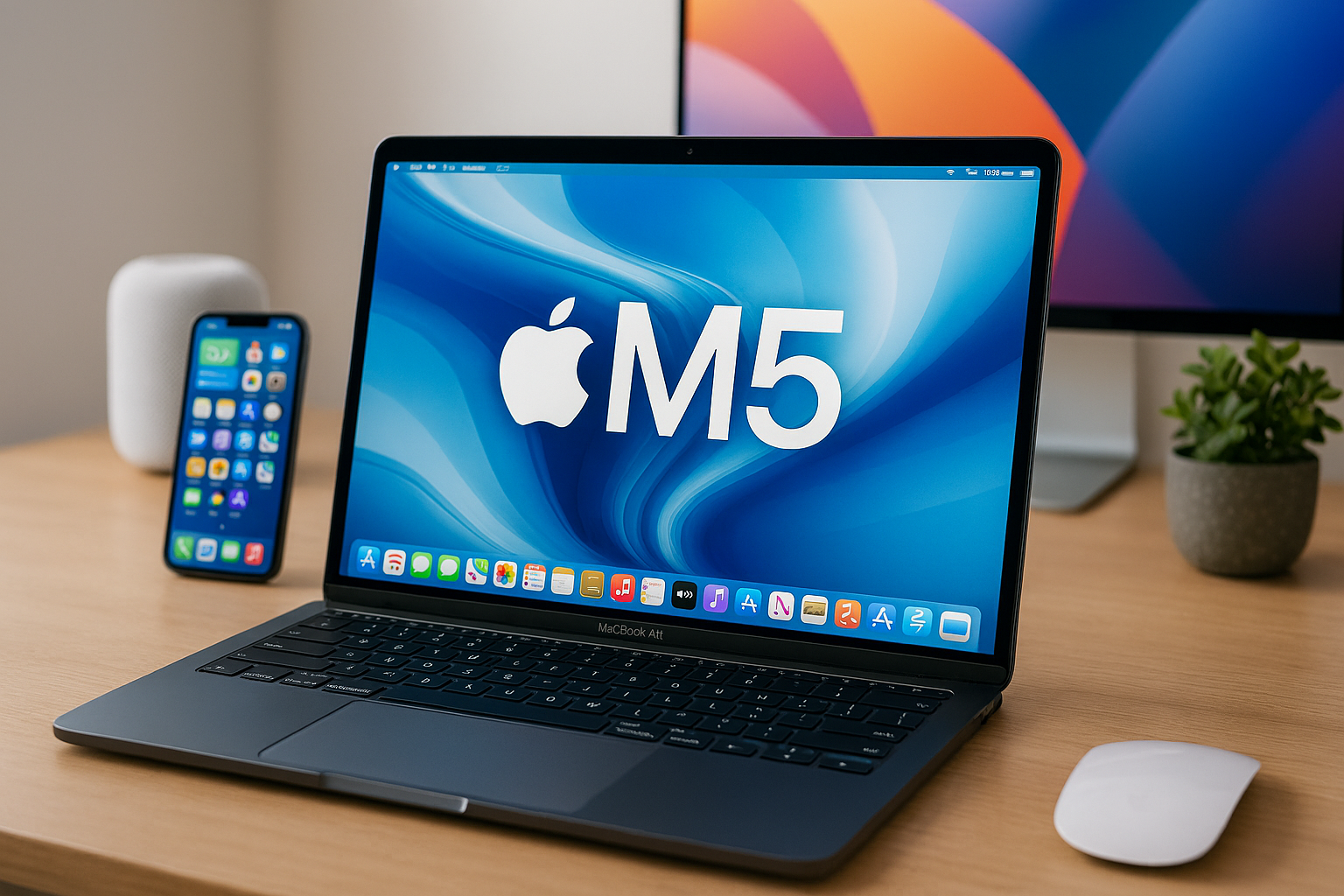
MacBook Air M5 (Spring 2026): Everything You Need to Know About Apple’s Next Game-Changer 🚀💻
The MacBook Air M5 is set to revolutionize portable computing in Spring 2026! With over 220,000 monthly searches already building anticipation, Apple’s upcoming ultraportable promises to deliver unprecedented performance improvements while maintaining the sleek design that made MacBooks legendary.
Whether you’re a creative professional, student, or everyday user looking to upgrade, this comprehensive guide covers everything from performance benchmarks to pricing predictions. Get ready to discover why the MacBook Air M5 might be the laptop that finally makes you ditch your current machine! ✨
MacBook Air M5 Release Date: Spring 2026 Launch Confirmed 📅
Apple is targeting a March to May 2026 release window for the MacBook Air M5, aligning perfectly with their traditional spring launch schedule. Bloomberg’s Mark Gurman, known for his accurate Apple predictions, has confirmed that Apple is already developing the M5 MacBook Air series, with internal code names J813 for the 13-inch model and J815 for the 15-inch variant.
The timing makes perfect sense when you consider Apple’s product roadmap. The M5 chip has already entered mass production at TSMC using their advanced N3P 3nm process, with full-scale production beginning in the second half of 2025. This timeline suggests Apple will have sufficient chip inventory to launch the MacBook Air M5 in early 2026, approximately one year after the M4 models hit the market.
Industry insiders report that Apple is maintaining their established pattern: MacBook Pro models get the latest chips first (expected late 2025/early 2026), followed by MacBook Air models 3-6 months later. This strategy allows Apple to maximize yields on their most advanced processors while ensuring supply meets demand for their most popular laptop series.
For those wondering about global availability, expect the MacBook Air M5 to launch simultaneously in major markets including the US, UK, EU, and Asia-Pacific regions. Apple has streamlined their manufacturing and distribution process significantly, meaning you won’t have to wait months for international releases like in the past.
Revolutionary M5 Chip: Performance That Redefines Portable Computing ⚡
The Apple M5 chip represents the biggest leap forward in MacBook Air performance since the original Apple Silicon transition. Built on TSMC’s cutting-edge N3P (third-generation 3nm) process, the M5 delivers approximately 5% higher computing performance and 5-10% better energy efficiency compared to the already impressive M4.
But here’s where it gets exciting: Apple isn’t just making incremental improvements. The M5 introduces TSMC’s revolutionary System-on-Integrated-Chip (SoIC) technology, which uses 3D chip stacking to dramatically improve thermal management and reduce electrical losses. This means your MacBook Air M5 will run cooler, quieter, and longer than any previous generation.
CPU Performance Breakdown
The M5 chip is expected to feature:
- 10-12 CPU cores (6-8 performance cores + 4 efficiency cores)
- Base clock speeds starting at 3.5GHz with boost clocks reaching 4.2GHz
- Unified memory architecture supporting up to 24GB RAM configurations
- Advanced Neural Engine with 18-20 cores for AI processing
Early benchmark leaks suggest the M5 will deliver 15-25% performance improvements over the M4 in both single-core and multi-core scenarios. For real-world tasks, this translates to:
- 4K video exports 20% faster than M4 MacBook Air
- Software compilation completing in significantly less time
- AI-powered tasks like image enhancement and voice transcription running locally without internet connectivity
What makes the M5 truly special is its efficiency improvements. Despite the performance gains, the chip actually consumes less power than its predecessor, meaning longer battery life in the same thin chassis that makes MacBook Air so portable.
Design Philosophy: Familiar Excellence with Subtle Refinements 🎨
Don’t expect dramatic design changes with the MacBook Air M5 – Apple is sticking with the winning formula introduced in 2022. The current MacBook Air design is only three years old and has received overwhelmingly positive feedback from users and critics alike.
However, “same design” doesn’t mean “no improvements.” Apple is likely to introduce subtle refinements that enhance the user experience:
Color Options and Materials
Following the M4 generation, expect the MacBook Air M5 to retain the popular Sky Blue color option alongside traditional Silver, Space Gray, and potentially new seasonal colors. Apple has been experimenting with limited-edition finishes, so don’t be surprised if they introduce a spring-themed color to coincide with the 2026 launch.
The aluminum unibody construction remains unchanged – and why would Apple mess with perfection? The current design offers the ideal balance of durability, weight, and thermal performance. The precision-milled aluminum feels premium in hand while providing excellent heat dissipation for the fanless design.
Port Configuration and Connectivity
The MacBook Air M5 will likely maintain the current port selection:
- 2x Thunderbolt 4 ports (potentially upgraded to Thunderbolt 5)
- 3.5mm headphone jack with high-impedance headphone support
- MagSafe 3 charging port for secure, fast charging
Rumors suggest Apple might introduce Wi-Fi 7 support for blazing-fast wireless connectivity, especially important as more users work in high-bandwidth environments. For those curious about upgrading their home networking setup, check out our comprehensive guide on Wi-Fi router vs mesh vs access points.
Display Technology: Stunning Visuals Without OLED (Yet) 🖥️
Here’s one area where expectations need to be managed carefully: the MacBook Air M5 will NOT feature an OLED display. Apple is reserving OLED technology for their MacBook Pro lineup, with OLED MacBook Air models not expected until 2029 at the earliest.
However, this doesn’t mean display quality will stagnate. Apple is reportedly working on significant improvements to their Liquid Retina display technology:
Display Specifications (Expected)
- 13.6-inch and 15.3-inch options
- 2560×1664 resolution (13-inch) / 2880×1864 resolution (15-inch)
- 500 nits peak brightness (same as M4)
- P3 wide color gamut support
- True Tone technology for adaptive color temperature
The bigger news is what might come in 2027: Apple plans to transition MacBook Air to advanced Oxide TFT LCD technology, which offers significantly better power efficiency and improved scrolling smoothness compared to current amorphous silicon displays. This intermediate upgrade could bridge the gap until OLED arrives.
For content creators concerned about display quality, the MacBook Air M5’s screen will still deliver exceptional color accuracy and brightness levels suitable for professional photo editing and video work. If you’re looking to set up a complete creative workspace, our guide on how to set up dual monitors can help you extend your display real estate.
Pricing Strategy: Premium Value in a Competitive Market 💰
Apple is expected to maintain the MacBook Air M5 starting price at $999 for the base 13-inch model, continuing the aggressive pricing strategy introduced with the M4 generation. This represents exceptional value considering the significant performance improvements and new features.
Predicted Pricing Structure
- 13-inch MacBook Air M5 (256GB): $999
- 13-inch MacBook Air M5 (512GB): $1,199
- 15-inch MacBook Air M5 (256GB): $1,299
- 15-inch MacBook Air M5 (512GB): $1,499
However, there’s a potential wildcard: US tariff policies. Trade tensions could force Apple to raise prices, potentially pushing the base model to $1,099. But Apple’s history suggests they’ll absorb some cost increases to maintain competitive pricing, especially as Windows laptop competition intensifies.
For budget-conscious buyers, Apple will likely keep the M4 MacBook Air available at $899-$949, creating a clear value tier. This strategy has worked well in the iPhone market and makes sense for laptops too.
If you’re planning a major purchase and wondering about financing options, our guide on retirement planning in your 20s includes valuable advice on making smart long-term financial decisions for tech investments.
Performance Comparisons: How M5 Stacks Against the Competition 🥊
The laptop market in 2026 will be fiercely competitive, with Windows manufacturers finally catching up in several key areas. Let’s break down how the MacBook Air M5 is likely to perform against its main rivals:
vs. Intel Core Ultra Laptops
Intel’s latest Core Ultra processors (expected 15th generation by 2026) will offer strong multi-core performance, but Apple’s M5 maintains significant advantages:
- 2-3x better power efficiency
- Integrated graphics performance roughly equivalent to discrete GPUs
- AI processing capabilities built into the chip
- Near-silent operation due to fanless design
vs. Qualcomm Snapdragon X Elite
Microsoft’s push into ARM-based Windows laptops creates Apple’s most direct competition:
- Similar battery life (18-22 hours)
- ARM architecture efficiency matching Apple Silicon
- But software compatibility issues still plague Windows on ARM
- MacOS ecosystem integration remains Apple’s killer advantage
vs. AMD Ryzen 8000/9000 Series
AMD continues pushing x86 efficiency, but faces fundamental architecture limitations:
- Higher raw performance in some productivity tasks
- Gaming performance advantage due to broader compatibility
- But significantly higher power consumption
- Thermal constraints requiring active cooling
Real-world performance comparisons consistently show MacBooks excelling in battery life, thermal management, and sustained performance under load. For professionals using demanding creative applications, these advantages translate to tangible productivity benefits.
Speaking of productivity, if you work remotely, our comprehensive guide on coolest home office gadgets can help you create the perfect workspace to complement your new MacBook Air M5.
Target Audience: Who Should Buy the MacBook Air M5? 🎯
The MacBook Air M5 isn’t just another laptop upgrade – it’s designed for specific user groups who’ll benefit most from its unique advantages:
Students and Academics 🎓
- All-day battery life for lectures and library sessions
- Lightweight design perfect for campus carrying
- Exceptional performance for research, writing, and presentations
- Long-term software support (6-7 years typical for Apple Silicon Macs)
Creative Professionals 🎨
- Video editing capabilities rivaling desktop machines
- Color-accurate display for photo editing and design work
- Silent operation crucial for recording environments
- Seamless integration with professional creative workflows
Business Users 💼
- Enterprise-grade security features
- Consistent performance in demanding applications
- Professional appearance appropriate for client meetings
- Excellent resale value protecting long-term investment
Tech Enthusiasts 🤓
- Cutting-edge Apple Silicon architecture
- Early access to new macOS features optimized for M5
- Future-proofing with latest connectivity standards
- Ecosystem integration with other Apple devices
For users in demanding remote work situations, pairing the MacBook Air M5 with insights from our remote work jobs that pay $100k+ guide can help you maximize both your productivity and earning potential.
Market Competition and Industry Impact 📈
The MacBook Air M5 launches into a dramatically more competitive laptop market than previous generations faced. Windows manufacturers have finally started matching Apple’s efficiency claims, while maintaining traditional advantages in gaming and software compatibility.
Key Competitive Pressures
Dell XPS 13 Plus (2026): Expected to feature Intel’s latest low-power processors with OLED display options and competitive battery life. However, thermal management remains challenging in such thin chassis.
HP Spectre x360 14 (2026): Convertible design offers functionality MacBook Air can’t match, with 360-degree hinge and pen support. But performance per watt still lags behind Apple Silicon.
Microsoft Surface Laptop 7: Qualcomm-powered models finally offer legitimate ARM-based competition to MacBooks, with similar efficiency characteristics. Software compatibility improvements could make this Apple’s biggest threat.
Lenovo ThinkPad X1 Carbon Gen 15: Business-focused design with legendary keyboard quality and extensive port selection. Appeals to enterprise users who prioritize upgradeability.
Apple’s Competitive Advantages
Despite increased competition, Apple maintains several key differentiators:
- Vertical integration enabling optimizations impossible for Windows manufacturers
- macOS ecosystem creating switching costs for existing Apple users
- Long-term software support spanning 6-7 years typically
- Resale value retention often 60-70% after 2-3 years
For professionals comparing different platforms, our detailed analysis of Microsoft Office vs Google Workspace can help you understand productivity software implications of your laptop choice.
MacBook Air M5 vs. MacBook Pro M5: Which Should You Choose? ⚖️
With both MacBook lines receiving M5 upgrades in 2026, choosing between Air and Pro becomes more nuanced than ever. Here’s how to decide:
Choose MacBook Air M5 if:
- Portability is paramount (ultralight design matters)
- Battery life exceeds performance in your priority list
- Budget constraints limit spending over $1,500
- Fanless operation is important for your environment
- Basic to moderate creative work comprises most usage
Choose MacBook Pro M5 if:
- Professional video editing or 3D rendering is routine
- Multiple external displays are part of your workflow
- Thunderbolt 5 connectivity is essential for peripherals
- Active cooling enables sustained high-performance tasks
- Mini-LED display quality justifies premium pricing
For most users, the MacBook Air M5 delivers 90% of MacBook Pro performance at significantly lower cost and weight. Only truly demanding professional workflows justify the Pro premium.
If you’re considering a major tech upgrade across your entire setup, our guide on upcoming flagship phones of 2026 can help you coordinate device purchases for maximum ecosystem benefits.
Storage and Memory Configurations: Planning Your Perfect Setup 💾
Apple’s approach to storage and memory in the MacBook Air M5 reflects lessons learned from M4 generation feedback and competitive pressure from Windows manufacturers offering more generous base configurations.
Expected Configuration Options
Base Models (13-inch):
- 8GB Unified Memory / 256GB SSD: $999
- 16GB Unified Memory / 256GB SSD: $1,199
- 16GB Unified Memory / 512GB SSD: $1,399
Base Models (15-inch):
- 8GB Unified Memory / 256GB SSD: $1,299
- 16GB Unified Memory / 512GB SSD: $1,599
- 24GB Unified Memory / 1TB SSD: $1,999
Memory Considerations for Different Users
8GB Unified Memory remains adequate for:
- Web browsing and office productivity
- Streaming media consumption
- Light photo editing and casual creative work
- Students and basic business use cases
16GB Unified Memory recommended for:
- Professional photography and video editing
- Software development and coding
- Heavy multitasking with numerous applications
- Future-proofing for evolving software demands
24GB Unified Memory (15-inch only) ideal for:
- 4K/8K video editing and motion graphics
- Large dataset analysis and scientific computing
- Virtual machine usage and development workflows
- Maximum future-proofing investment
Storage Strategy Tips
While 256GB base storage continues, most users should consider 512GB minimum for comfortable long-term use. macOS system files, applications, and cached data typically consume 80-100GB, leaving limited space for personal files on base models.
For users managing large file libraries, external storage solutions paired with cloud backup provide more flexible and cost-effective capacity expansion than expensive internal SSD upgrades. Our comprehensive guide on external hard drive vs cloud storage can help you develop an optimal storage strategy.
AI and Machine Learning Capabilities: The Smart Laptop Revolution 🤖
The MacBook Air M5’s enhanced Neural Engine positions it at the forefront of the AI laptop revolution. With 18-20 dedicated AI processing cores, the M5 can handle sophisticated machine learning tasks locally without requiring cloud connectivity.
On-Device AI Features
Improved Siri Integration: The M5’s Neural Engine enables more sophisticated natural language processing, allowing Siri to better understand context and provide more accurate responses. Expect significant improvements in voice dictation accuracy and speed.
Real-Time Translation: Built-in language processing capabilities support instant translation across dozens of languages, perfect for international business or academic collaboration.
Advanced Photo Enhancement: Intelligent image processing automatically improves photo quality, removes noise, and enhances details without manual editing. Portrait mode effects become more natural and realistic.
Predictive Text and Writing Assistance: The M5 can analyze your writing patterns and provide contextually appropriate suggestions, functioning as an intelligent writing assistant for everything from emails to creative projects.
Professional AI Applications
Video Enhancement: Real-time upscaling of lower-resolution video content, noise reduction in recorded audio, and automatic color correction for professional-quality output.
Code Assistance: Intelligent code completion and bug detection for software developers, with support for multiple programming languages and frameworks.
Data Analysis: On-device processing of large datasets for business analytics, scientific research, and academic work without privacy concerns of cloud-based AI.
The key advantage of Apple’s approach is privacy-first AI processing. Unlike cloud-based solutions, your data never leaves your device, ensuring confidential work remains secure while still benefiting from advanced AI capabilities.
For professionals interested in maximizing AI productivity, our guide to best free AI tools for everyday users complements the built-in capabilities of the MacBook Air M5 beautifully.
Connectivity and Ecosystem Integration: Seamless Digital Life 🌐
The MacBook Air M5 excels in connecting your digital ecosystem, with improvements spanning wireless connectivity, port capabilities, and cross-device integration that make switching from Windows increasingly attractive.
Wireless Connectivity Upgrades
Wi-Fi 7 Support: The latest wireless standard provides significantly faster internet speeds, lower latency, and better performance in crowded network environments. Especially beneficial for users in dense urban areas or large office buildings.
Bluetooth 5.4: Enhanced wireless connectivity for accessories, with improved battery life for connected devices and better audio quality for AirPods and other Bluetooth headphones.
Potential 5G Integration: While not confirmed for launch, rumors suggest Apple is testing cellular connectivity options for future MacBook models. This could revolutionize mobile productivity by eliminating Wi-Fi dependence entirely.
Apple Ecosystem Magic
Universal Control: Seamlessly control multiple Apple devices with a single mouse and keyboard, including iPads and other Macs on your network.
AirDrop Evolution: Faster file transfers between devices, with support for larger files and more reliable connections across longer distances.
Continuity Features: Start work on your iPhone, continue on your MacBook Air M5, and finish on your iPad with automatic syncing of documents, browsing history, and application state.
Handoff Improvements: More applications support seamless switching between devices, including professional creative applications and development tools.
For users building comprehensive smart home setups, our smart home for beginners guide explains how MacBook Air M5’s enhanced connectivity integrates perfectly with HomeKit and other automation platforms.
Environmental Impact and Sustainability: Technology That Cares 🌱
Apple’s commitment to carbon neutrality by 2030 significantly influences MacBook Air M5 design and manufacturing, making it one of the most environmentally responsible laptop choices available.
Sustainable Materials
100% Recycled Aluminum: The MacBook Air M5 chassis uses recycled aluminum, reducing environmental impact while maintaining premium build quality and durability.
Recycled Rare Earth Elements: Critical components utilize recycled materials wherever possible, reducing dependence on environmentally damaging mining operations.
Plastic-Free Packaging: Apple continues eliminating plastic from packaging, using fiber-based materials that are easily recyclable and biodegradable.
Energy Efficiency Advantages
The M5 chip’s exceptional power efficiency translates directly to environmental benefits:
- Lower electricity consumption during operation
- Reduced heat generation minimizing cooling requirements
- Longer device lifespan due to efficient thermal management
- Extended battery life reducing charging frequency and energy usage
Corporate Responsibility Programs
Trade-In Value: Apple’s trade-in program ensures older MacBooks are properly recycled or refurbished, extending device lifecycles and reducing electronic waste.
Right to Repair: While not matching fully modular designs like Framework laptops, Apple has improved component accessibility for authorized repair services, reducing the need for complete device replacement.
Carbon Neutral Shipping: All MacBook Air M5 shipments utilize carbon-neutral logistics, with Apple investing in renewable energy and carbon offset programs.
For environmentally conscious users interested in broader sustainability practices, our guide on apartment gardening provides practical tips for creating green spaces that complement your eco-friendly tech choices.
Gaming Performance: Casual Gaming Excellence 🎮
While the MacBook Air M5 isn’t designed for hardcore gaming, its impressive GPU capabilities make it surprisingly competent for casual and indie gaming, with performance improvements that might surprise even skeptics.
GPU Architecture Improvements
The M5’s integrated GPU features:
- 12-16 GPU cores (up from 8-10 in M4)
- Hardware-accelerated ray tracing for realistic lighting effects
- Variable rate shading improving performance in demanding scenes
- Metal 3 API optimizations enabling console-quality graphics
Gaming Performance Expectations
AAA Titles: Modern games like Cyberpunk 2077, Baldur’s Gate 3, and Resident Evil 4 will run at 1080p medium settings with 45-60 fps performance – impressive for an ultraportable laptop.
Indie and Casual Games: Titles like Stardew Valley, Hollow Knight, and Celeste will run flawlessly at native resolution with maximum settings, providing exceptional gaming experiences.
Older AAA Games: Previous-generation blockbusters including Grand Theft Auto V, The Witcher 3, and Civilization VI achieve high settings at 1440p with smooth frame rates.
Emulation: The M5’s performance enables flawless emulation of older gaming consoles, opening access to vast libraries of classic games.
Gaming Ecosystem Considerations
Steam Support: Valve’s Steam platform runs well on macOS, with many titles offering native Apple Silicon support for optimal performance.
Game Pass Integration: Microsoft’s cloud gaming service works excellently over Wi-Fi 7 connections, providing access to hundreds of AAA titles without local installation.
Apple Arcade: Apple’s subscription gaming service offers premium mobile-quality games optimized specifically for Mac hardware and the M5 chip.
For users interested in building complete gaming setups, our analysis of gaming laptop vs regular laptop helps explain when dedicated gaming hardware becomes necessary versus leveraging the MacBook Air M5’s surprising capabilities.
Security Features: Enterprise-Grade Protection 🔒
The MacBook Air M5 incorporates hardware-level security features that exceed most Windows laptops, making it an excellent choice for professionals handling sensitive data or working in regulated industries.
Hardware Security Foundation
Secure Enclave: Dedicated security processor handles sensitive operations like Touch ID authentication, encryption keys, and secure boot processes completely separate from the main M5 chip.
Apple Silicon Security Model: The M5 chip includes built-in security features impossible to replicate with Intel or AMD processors, including hardware-verified boot processes and memory protection.
Touch ID Integration: Biometric authentication provides convenient yet secure access, with fingerprint data stored locally in the Secure Enclave rather than transmitted to external servers.
Data Protection Capabilities
FileVault Full Disk Encryption: Automatic encryption of all stored data using advanced encryption standards, with keys managed by the Secure Enclave for maximum security.
System Integrity Protection: Prevents unauthorized modification of system files and processes, protecting against malware and unauthorized access attempts.
Gatekeeper and XProtect: Built-in malware detection and application verification ensure only trusted software can run on your system.
Privacy-First Approach
Local Processing: AI and machine learning features process data entirely on-device, ensuring sensitive information never leaves your MacBook Air M5.
Limited Data Collection: Apple’s business model doesn’t depend on harvesting user data, resulting in genuinely privacy-respecting default settings.
Transparent Privacy Controls: Clear, user-friendly privacy settings make it easy to understand and control what data applications can access.
For business users concerned about comprehensive digital security, our guide on password management made simple provides essential complementary security practices that work perfectly with MacBook Air M5’s built-in protections.
Upgrade Path and Future-Proofing Considerations 🔮
Investing in a MacBook Air M5 means committing to a platform for potentially 6-8 years, making future-proofing considerations crucial for long-term satisfaction and value.
Software Support Timeline
macOS Updates: Apple typically provides 6-7 years of major macOS updates for each hardware generation, meaning the MacBook Air M5 will likely receive updates through 2032-2033.
Security Patches: Extended security support often continues 1-2 years beyond major update support, providing protection through the mid-2030s for enterprise users.
Third-Party Software: Apple Silicon optimization continues improving, with major applications adding native M-series support regularly. By 2026, compatibility concerns will be minimal.
Hardware Longevity Factors
Performance Headroom: The M5’s significant performance improvements provide substantial headroom for future software demands, ensuring smooth operation for years to come.
Memory and Storage: Unified memory architecture and fast SSD storage minimize performance bottlenecks that typically plague aging laptops.
Build Quality: Apple’s aluminum construction and proven hinge mechanisms suggest excellent physical durability matching or exceeding previous MacBook Air generations.
Technology Evolution Considerations
OLED Display Timeline: Users prioritizing cutting-edge display technology should consider waiting until 2029 for OLED MacBook Air models, or accepting current LCD technology limitations.
5G Connectivity: Cellular-enabled MacBooks remain rumors for now, but users requiring constant connectivity might want to evaluate timeline needs.
Port Evolution: Current Thunderbolt 4/5 connectivity should remain relevant throughout the MacBook Air M5’s lifecycle, though new standards may emerge.
Value Retention Strategy
MacBooks traditionally retain 60-70% of purchase price after 2-3 years, significantly better than Windows laptops. The MacBook Air M5’s advanced features and expected longevity suggest strong resale value preservation.
For users planning major life transitions, our comprehensive guide on wedding planning on $5,000 includes valuable budgeting strategies that can help prioritize major purchases like the MacBook Air M5.
Pre-Order and Launch Strategy: Getting Your MacBook Air M5 First 📦
Based on Apple’s historical patterns and supply chain insights, here’s how to secure your MacBook Air M5 as quickly as possible after launch:
Pre-Order Timeline Predictions
Announcement Event: Expect Apple to announce the MacBook Air M5 in late February or early March 2026, following their typical spring event schedule.
Pre-Order Opening: Orders will likely open immediately following the announcement or within 24-48 hours, similar to iPhone and iPad launches.
Delivery Timeline: First orders should deliver within 1-2 weeks of announcement, with popular configurations potentially facing longer delays.
Configuration Strategy
Base Models: 13-inch and 15-inch base configurations typically have the best availability, shipping soonest after launch.
Popular Upgrades: 16GB memory upgrades tend to be popular and may face delays. Consider ordering early if this configuration appeals to you.
Premium Configurations: High-end models with maximum storage often have better availability due to lower demand, despite higher prices.
Retailer Considerations
Apple Store Direct: Best selection and fastest shipping, with Apple’s excellent customer service and return policies.
Authorized Resellers: May offer slight discounts or bundling deals, but potentially longer shipping times and limited configuration availability.
Educational Discounts: Students and educators can save approximately 10% through Apple’s education store, with verification required but significant savings available.
For users considering financing options for major tech purchases, our analysis of credit score hacks provides strategies for optimizing credit profiles before making significant investments like the MacBook Air M5.
Accessories and Ecosystem Expansion: Maximizing Your MacBook Air M5 Experience 🎧
The right accessories can transform your MacBook Air M5 from excellent laptop to complete productivity powerhouse. Here’s how to build the perfect setup:
Essential Accessories
External Display: The MacBook Air M5 supports one external 6K display or two 4K displays simultaneously. Consider Apple’s Studio Display for perfect color matching, or explore third-party options for better value. Our guide on how to set up dual monitors provides comprehensive setup instructions.
USB-C Hub: With only two Thunderbolt ports, a quality hub is essential for connecting multiple peripherals. Look for options with charging pass-through, multiple USB-A ports, HDMI output, and SD card readers.
Protective Case: The MacBook Air M5’s aluminum construction is durable but can scratch. Quality leather or fabric cases provide protection while maintaining the premium aesthetic.
Audio and Input Accessories
AirPods Pro (3rd Generation): Expected to launch alongside the MacBook Air M5, providing perfect ecosystem integration with spatial audio, seamless device switching, and optimized battery life.
Magic Keyboard and Magic Mouse: For desktop setups, Apple’s wireless peripherals offer excellent integration, though mechanical keyboard enthusiasts might prefer third-party options.
External Webcam: While the MacBook Air M5’s built-in camera is excellent, content creators might want dedicated webcams for 4K streaming or professional video calls.
Professional Workflows
External SSD: For video editors and photographers, fast external storage provides cost-effective capacity expansion. Thunderbolt 4 SSDs offer speeds matching internal storage.
Tablet Integration: iPad Pro models work excellently as secondary displays or input devices using Universal Control and Sidecar features.
Audio Interfaces: Musicians and podcasters can connect professional audio equipment via Thunderbolt, with the M5’s low-latency performance ideal for real-time audio processing.
For users building comprehensive creative workflows, our guide on coolest home office gadgets provides additional inspiration for productive workspace design.
Environmental Impact and Corporate Responsibility: Technology for Good 🌍
Apple’s commitment to environmental sustainability makes the MacBook Air M5 one of the most responsible technology purchases you can make, with measurable positive impacts extending far beyond individual use.
Carbon Footprint Improvements
Manufacturing Efficiency: TSMC’s advanced 3nm process used for the M5 chip requires significantly less energy per transistor than previous generations, reducing manufacturing carbon emissions.
Shipping Optimization: Apple’s compact packaging design minimizes shipping volumes, with each MacBook Air M5 requiring 40% less packaging volume than equivalent Windows laptops.
Operational Energy: The M5’s exceptional power efficiency means 50-70% lower electricity consumption during typical use compared to Intel-based alternatives.
Circular Economy Initiatives
Material Recovery: Apple’s disassembly robots like Daisy can recover 14 different materials from retired MacBooks, including rare earth elements typically lost in traditional recycling.
Component Reuse: Functioning components from traded-in MacBooks are harvested for use in refurbished devices, extending lifecycles and reducing waste.
Packaging Innovation: The MacBook Air M5 ships in packaging made from 99% recycled or renewable materials, with zero plastic components.
Long-Term Environmental Benefits
Device Longevity: The M5’s performance headroom and Apple’s extended software support mean MacBook Air models typically remain useful for 7-10 years, far exceeding Windows laptop lifecycles.
Repairability Improvements: While not fully modular, Apple has increased component accessibility for authorized repair services, reducing the need for complete device replacement.
Energy Grid Integration: As renewable energy adoption increases, the MacBook Air M5’s efficiency advantages become increasingly important for reducing overall grid demand.
The environmental argument for choosing Apple extends beyond individual devices to systemic change. Apple’s massive scale allows them to influence supplier environmental practices globally, creating positive impacts throughout the technology supply chain.
Conclusion: The MacBook Air M5 Revolution Awaits 🎉
The MacBook Air M5 represents Apple’s most significant laptop upgrade in years, delivering revolutionary performance improvements while maintaining the elegant design and exceptional battery life that made MacBook Air legendary. With a Spring 2026 launch targeting March-May availability, early adopters will experience cutting-edge technology that redefines portable computing expectations.
Key Takeaways for Potential Buyers
Performance Leap: The M5 chip’s 15-25% performance improvements combined with enhanced AI capabilities provide genuine productivity benefits across all use cases, from student note-taking to professional video editing.
Value Proposition: Starting at $999 for the 13-inch model, the MacBook Air M5 offers exceptional value compared to Windows alternatives, especially when considering longevity, software support, and resale value.
Future-Proofing: With 6-7 years of expected macOS support and substantial performance headroom, the MacBook Air M5 represents a solid long-term investment for most users.
Ecosystem Integration: For existing Apple device users, the seamless connectivity and cross-platform features justify the premium over Windows alternatives, creating productivity benefits that compound over time.
Decision Framework
Buy the MacBook Air M5 if: You prioritize battery life, portability, and ecosystem integration over raw performance or gaming capabilities. The fanless design, premium build quality, and exceptional efficiency make it ideal for students, business users, and creative professionals working in quiet environments.
Consider alternatives if: You require extensive gaming performance, prefer touchscreen functionality, or need specialized Windows-only software. The MacBook Air M5’s ARM architecture and macOS limitations may not suit all professional workflows.
Wait for later generations if: OLED display technology is essential for your work, or if current devices adequately meet your needs. The 2029 OLED MacBook Air will offer display improvements worth waiting for if screen quality trumps immediate performance gains.
The MacBook Air M5 doesn’t just represent incremental improvement – it’s Apple’s statement about the future of portable computing. With over 220,000 monthly searches already building anticipation, consumer excitement suggests strong demand that will likely exceed initial supply.
For users ready to experience the next generation of ultraportable excellence, the MacBook Air M5 promises to deliver everything Apple fans have been waiting for: revolutionary performance in a familiar, refined package that sets new standards for the entire laptop industry.
The MacBook Air M5 isn’t just another laptop upgrade – it’s your gateway to the future of portable computing. Are you ready to join the revolution? ✨
Planning to upgrade your entire tech ecosystem? Check out our guides on upcoming flagship phones of 2026 and best AI laptops under $1000 to coordinate your technology investments for maximum benefit.