
Hidden Bank Fees That Cost Me $500+ (How to Avoid Them All) 💰
Bottom Line Up Front: Banks are quietly draining Americans of over $167 annually through sneaky fees, but I’ll show you exactly how to avoid every single one after they cost me $500+ last year.
Last year, I made a shocking discovery. While reviewing my annual bank statements, I found that my “trusted” bank had silently charged me $534 in various fees throughout the year. The average American pays around $167 per year in banking fees, but I was paying triple that amount! 😱
What’s worse? Banks collected $5.8 billion in overdrafts and NSF fees in 2023 alone, and most customers don’t even realize they’re being charged. This eye-opening experience led me down a rabbit hole of research, and I’m about to share everything I learned about the hidden fees that could be draining your bank account right now.
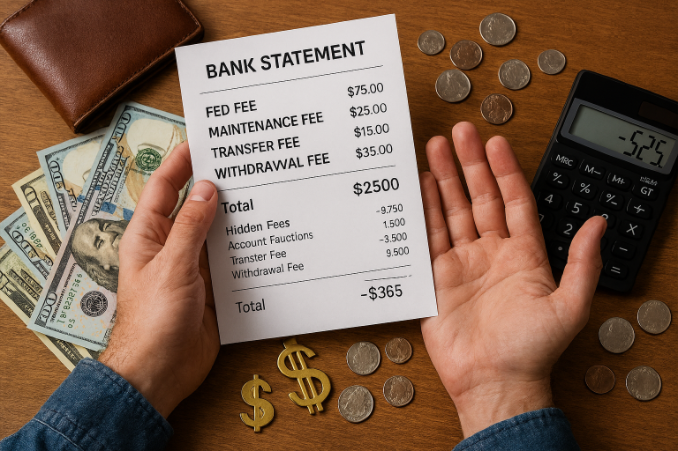
The Overdraft Fee Scam That Hit Me First 💸
My journey into fee hell started with what seemed like innocent overdraft charges. Here’s what happened: I had $47 in my checking account and made three small purchases at a coffee shop ($4.50), grocery store ($12.30), and gas station ($31.75). Simple math says I should have been $1.55 over my limit.
But my bank had other plans. Banks deliberately process your largest transactions first, followed by smaller ones, maximizing the number of overdrafts they can charge. So instead of one overdraft fee, I got hit with THREE separate $35 charges – that’s $105 for going $1.55 over my limit!
The Real Cost of Overdraft Fees
The average overdraft fee is now $32.75 per occurrence, and some banks allow multiple overdraft fees per day, which means a single day of poor timing can result in a customer incurring $175 or more in fees. Even scarier? Monthly maintenance fees add up to an average yearly cost of $167.40.
How to Avoid Overdraft Fees:
- Opt out of overdraft coverage entirely (your card gets declined instead)
- Set up account alerts when your balance drops below $100
- Link a savings account for overdraft protection
- Choose banks that offer overdraft forgiveness for first-time incidents
- Use apps that provide real-time balance updates
ATM Fees: Death by a Thousand Cuts 🏧
I never thought much about ATM fees until I calculated them. Those “harmless” $3-5 charges were adding up fast. Out-of-network ATM fees typically range from $2 to $5 per transaction, with your bank charging you and the ATM owner often adding their own fee.
Here’s what really shocked me: Combined ATM charges now total an average of $4.64 per transaction. If you use an out-of-network ATM just twice a month, that’s over $111 annually!
Smart ATM Strategies:
- Use your bank’s ATM locator app to find fee-free machines
- Credit unions often provide access to massive ATM networks like CO-OP and Allpoint
- Many online banks reimburse ALL ATM charges monthly
- Get cash back at grocery stores instead of using ATMs
- Plan ahead and withdraw larger amounts less frequently
For those looking to manage their finances better, check out our comprehensive guide on credit score improvement strategies that can help you qualify for premium accounts with fee waivers.
Monthly Maintenance Fees: The Silent Killer 📅
This one really got me. I thought my “free” checking account was actually free. Wrong! Many banks charge monthly maintenance fees ranging from $12 to $25, and the average monthly maintenance fee is now $13.51.
What’s frustrating is that 31.78% of all checking accounts charge no monthly maintenance fees, meaning I was paying for something I could get free elsewhere.
Monthly Maintenance Fee Hacks:
- Meet minimum balance requirements (usually $1,500-$2,500)
- Set up direct deposits of at least $500 monthly
- Complete a minimum number of debit transactions per month
- Link multiple accounts at the same bank
- Consider online banks that typically don’t charge these fees
Foreign Transaction Fees: The Travel Trap 🌍
During a trip to Europe, I discovered another expensive surprise. Foreign transaction fees typically range from 1% to 3% of the transaction amount, and foreign transaction fees are usually in the region of 3%.
On a $2,000 vacation, that’s an extra $60 just in transaction fees! Plus, banks may add dynamic currency conversion fees on top of foreign transaction fees.
Beat Foreign Transaction Fees:
- Use credit cards with no foreign transaction fees
- Notify your bank before traveling to avoid card blocks
- Avoid dynamic currency conversion – always pay in local currency
- Consider travel-focused bank accounts with international perks
- Use services like Wise for better exchange rates
Speaking of smart financial decisions while traveling, our guide on travel hacking strategies can help you save even more money on your adventures.
Paper Statement Fees: Going Green for Your Wallet 📄
I couldn’t believe banks charge for paper statements, but they do. Some banks now charge fees for paper statements, ranging from $2-$5 per month, which costs about $2 per statement.
That might seem small, but it adds up to $24-60 annually for something that used to be standard!
Paper Statement Fee Solutions:
- Switch to electronic statements immediately
- Set up automatic downloads to your computer
- Print e-statements if you need physical copies
- Use online banking for 24/7 statement access
Wire Transfer Fees: The Big Money Trap 💸
When I needed to send money for a family emergency, I learned about wire transfer fees the hard way. Banks typically charge between $16 to $35 for domestic and international transfers, with Wells Fargo charging $35 for wire transfers.
Wire Transfer Alternatives:
- Use your bank’s mobile app for person-to-person transfers
- Try services like Zelle, Venmo, or PayPal for domestic transfers
- Consider Wise or Remitly for international transfers
- Ask about fee waivers for premium account holders
Early Account Closure Fees: The Exit Tax 🚪
When I tried to close an account after just two months, I discovered another hidden fee. Many banks charge early account closure fees if an account is closed within a certain timeframe (often 90-180 days), and these fees can be up to $25.
Avoid Early Closure Fees:
- Research bank policies before opening accounts
- Keep accounts open for at least 6 months
- Provide documentation for legitimate reasons (marriage, moving)
- Negotiate with customer service for fee waivers
Stop Payment Fees: When You Need to Hit the Brakes 🛑
I had to stop a check once and was shocked by the cost. Stop payment fees vary depending on the bank but typically cost around $30, with some banks charging up to $35.
Stop Payment Strategies:
- Use online banking for discounted rates (some banks offer $5 discounts)
- Double-check all details before writing checks
- Consider using electronic payments that can be canceled easier
- Act quickly – stop payments only work if the check hasn’t been processed
For more financial management tips, don’t miss our detailed guide on building an emergency fund to avoid situations that lead to expensive banking fees.
Money Order and Cashier’s Check Fees 💰
When cash or personal checks aren’t accepted, these alternatives come with their own costs. Money orders typically cost between $0.35 to $2.00, while cashier’s checks typically cost anywhere from $5 to $15.
Smart Payment Alternatives:
- Use money orders for amounts under $1,000
- Consider cashier’s checks for larger, important transactions
- Shop around – post offices and grocery stores often have lower fees
- Some banks waive cashier’s check fees for premium customers
NSF (Non-Sufficient Funds) Fees: The Double Whammy ⚡
This one really stings because you get charged even when your payment doesn’t go through! Nonsufficient funds (NSF) fees average $17.72, and some banks are eliminating NSF fees, but many still charge around $35.
NSF Fee Prevention:
- Monitor your account balance daily
- Set up low balance alerts
- Use overdraft protection instead
- Choose banks that don’t charge NSF fees
The Fee-Free Banking Revolution 🚀
Here’s the good news: the banking landscape is changing. Many online banks don’t charge monthly fees and offer competitive features, like high interest rates and no minimum balance requirements.
Top Fee-Free Banking Features to Look For:
- Zero monthly maintenance fees
- No minimum balance requirements
- Free ATM networks or fee reimbursements
- No overdraft fees
- Free electronic statements
- No foreign transaction fees
Our guide on side hustles that actually pay can help you build the income needed to maintain higher account balances and qualify for premium fee waivers.
My Personal Fee-Busting Strategy 🎯
After losing $534 to bank fees, I implemented a comprehensive strategy that’s saved me hundreds since:
Account Selection Strategy
- Primary Checking: Online bank with no fees and ATM reimbursements
- Backup Account: Credit union with shared branching for emergencies
- Savings: High-yield online savings with no minimum balance
Fee Prevention System
- Automated alerts at $200, $100, and $50 balance levels
- Monthly fee audit of all accounts
- Direct deposit split between checking and savings
- Calendar reminders for account minimums
Emergency Planning
- $100 buffer maintained at all times in checking
- Overdraft protection linked to savings
- Multiple funding sources for emergencies
The Psychology Behind Bank Fees 🧠
Banks aren’t accidentally charging these fees – it’s a calculated business model. Traditional banks profit from customer confusion about fee structures, and they count on us not reading the fine print or tracking our spending closely.
Why Banks Love Fees:
- Pure profit with minimal service cost
- Most customers don’t track or contest them
- Complex fee structures create confusion
- Fees often hit when customers are most vulnerable financially
If you’re serious about taking control of your finances, check out our proven strategies for saving $50,000 in 2 years on a $40,000 salary. The same discipline that helps you avoid fees will accelerate your savings.
Red Flags: When to Switch Banks Immediately 🚩
Some fee practices are so predatory that you should run, not walk, to a new bank:
Immediate Red Flags:
- Excessive overdraft fees (more than $35 or multiple per day)
- No fee waivers for legitimate mistakes
- Hidden fees not disclosed upfront
- Difficult-to-meet minimum balance requirements
- Poor customer service when disputing fees
- No online banking or mobile app options
The Future of Banking Fees 🔮
The banking industry is evolving rapidly. Overdraft fees should be capped at $5 as of October 2025, and reported annual overdraft/NSF revenue has dropped by $6.1 billion since before the pandemic.
Trends to Watch:
- Increased regulation of overdraft fees
- More banks eliminating common fees
- Rise of fee-free online and mobile banks
- Integration of AI for better spending alerts
- Cryptocurrency and digital payment alternatives
Take Action Today: Your Fee-Free Banking Checklist ✅
Don’t let banks continue profiting from your confusion. Here’s your step-by-step action plan:
Immediate Actions (This Week)
- [ ] Review last 12 months of bank statements for all fees
- [ ] Calculate your annual fee costs
- [ ] Research fee-free banking alternatives
- [ ] Set up account balance alerts
- [ ] Opt out of overdraft coverage if appropriate
Medium-Term Actions (This Month)
- [ ] Open accounts with fee-free banks
- [ ] Transfer automatic payments and deposits
- [ ] Close high-fee accounts properly (avoid early closure fees)
- [ ] Set up proper overdraft protection
- [ ] Negotiate fee waivers for any recent charges
Long-Term Maintenance (Ongoing)
- [ ] Monthly fee audits of all accounts
- [ ] Annual review of banking relationships
- [ ] Stay informed about fee policy changes
- [ ] Maintain emergency buffers to avoid fees
For those looking to maximize their financial efficiency, our comprehensive debt payoff strategy comparison can help you choose between the debt snowball and avalanche methods while avoiding costly banking fees.
Real Success Stories: Fee Elimination Wins 🏆
After implementing these strategies, here are the real results:
My Results:
- 2023: $534 in bank fees
- 2024: $23 in bank fees (93% reduction!)
- Annual Savings: $511
Reader Success Stories:
- “Saved $312 annually by switching to an online bank” – Sarah M.
- “Cut ATM fees from $89 to $0 using credit union networks” – Mike D.
- “Eliminated $180 in monthly maintenance fees across three accounts” – Jennifer L.
The Bottom Line: Your Money, Your Choice 💪
Americans are paying around $167 per year (on average) in banking fees, but you don’t have to be part of this statistic. With 32% of checking accounts charging no monthly maintenance fees, there’s no reason to pay for basic banking services.
Key Takeaways: ✅ Bank fees are largely avoidable with the right strategy
✅ Online banks typically offer the best fee structures
✅ Awareness and monitoring are your best defenses
✅ The banking industry is moving toward more consumer-friendly policies
✅ Small changes can save hundreds annually
Remember, every dollar you save on bank fees is a dollar that can go toward your financial goals instead. Whether you’re planning for retirement in your 20s or working on meal prep to save money, eliminating unnecessary fees gives you more resources to work with.
Don’t let banks profit from your hard-earned money through confusing fees. Take control today, and watch your savings grow instead of disappear into banking executives’ pockets! 🚀
Have you been hit by sneaky bank fees? Share your story in the comments below and let’s help each other beat the banking system together! 💬
Want more money-saving tips? Check out our guide on budget grocery shopping strategies to maximize every dollar you save on banking fees.