
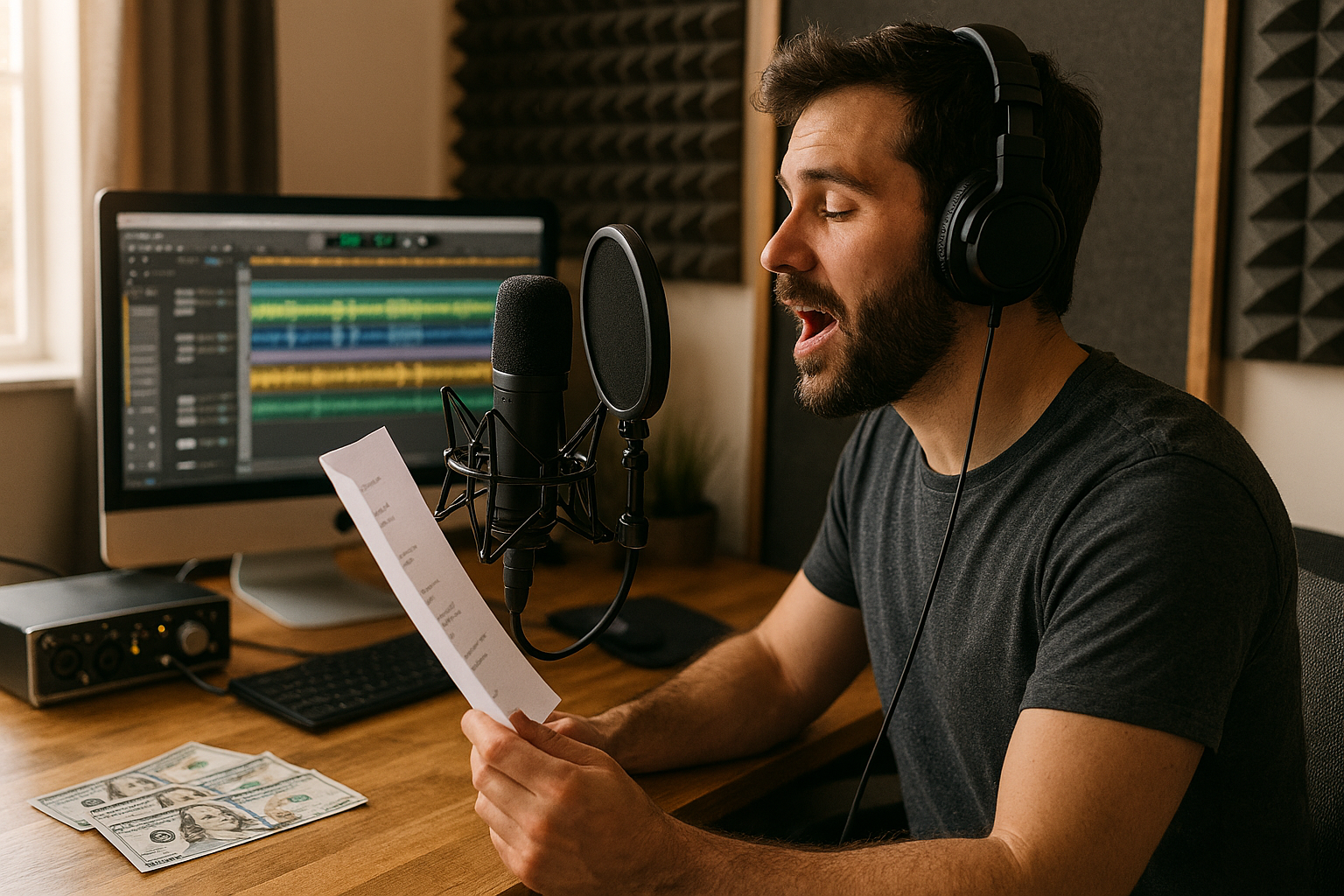
$5000/Month from Home Studio 🎤
Are you tired of traditional side hustles that barely cover your coffee expenses? 😴 What if I told you that people are making $5000+ monthly from the comfort of their bedrooms, using nothing more than their voice and a microphone? Welcome to the explosive world of voice acting side hustle – where your vocal cords become your money-making machine! 💰
The voice acting industry has absolutely exploded in 2025, with the global dubbing and voice-over market reaching a whopping $4.2 billion and projected to hit $8.6 billion by 2034. That’s a staggering 7.4% annual growth rate! Whether you’re looking to supplement your income or completely transform your financial situation, starting a voice acting side hustle could be the game-changer you’ve been searching for.
Voice acting side hustle opportunities are everywhere – from audiobook narration paying $200-$500 per finished hour to commercial work bringing in $100-$10,000 per project. The beauty? You can do this from anywhere with a decent internet connection and basic recording setup!
Why Voice Acting Side Hustle is Blowing Up Right Now 🚀
Think about your daily life for a second. How many times do you hear voice-overs? Your morning alarm app, podcast during commute, YouTube videos, Netflix shows, video games, audiobooks, GPS navigation, phone systems, commercials – voice actors are literally everywhere! 📱
The digital revolution has created an insatiable hunger for audio content. Market research suggests that the global voice-over market size was valued at around USD 1.5 billion in 2021 and is expected to reach USD 2.3 billion by 2026, growing at a CAGR of 9%. But here’s the kicker – most people don’t even realize this opportunity exists!
The perfect storm of factors driving demand:
- Streaming platforms need multilingual content (Netflix content is now available in 62 languages!)
- E-learning industry boom (especially post-pandemic growth)
- Podcast explosion (over 4 million podcasts exist today)
- Video marketing surge (social media videos have 95% retention vs 10% for text)
- Audiobook popularity skyrocketing
- Corporate training moving online
- Video game industry hitting $200+ billion
Just like how remote work jobs that pay $100k have become mainstream, voice acting has transitioned from Hollywood exclusivity to accessible home-based opportunity.
Real Numbers: What Voice Actors Actually Earn 💸
Let’s cut through the hype and talk real money. As of Aug 1, 2025, the average hourly pay for a Voice Actor in the United States is $48.17 an hour. While ZipRecruiter is seeing hourly wages as high as $76.92 and as low as $5.29, the majority of Voice Actor wages currently range between $39.18 (25th percentile) to $60.10 (75th percentile) across the United States.
Here’s the breakdown by experience level:
Beginner Voice Actors (Months 1-6):
- Part-time income: $500-$2,000/month
- Typical rates: $10-$100 per finished hour for audiobooks
- Commercial work: $100-$350 for local radio spots
- Fiverr gigs: $35-$73 average project value
Intermediate Voice Actors (6 months-2 years):
- Part-time income: $2,000-$5,000/month
- Audiobook rates: $150-$300 per finished hour
- Commercial rates: $200-$1,000 per project
- Corporate work: $300-$1,500 per project
Expert Voice Actors (2+ years):
- Full-time potential: $50,000-$148,000 annually
- Premium rates: $300-$500+ per finished hour
- National commercials: $1,000-$10,000 per spot
- Animation work: Up to $10,000 for starring roles
Success story alert: Dom and Nicole Draper from TheVoiceoverCouple.com are award-winning voice over artists. They get paid to talk! As professional voice over artists, they’ve worked with some of the biggest brands in the world, including Nike, Netflix, and Adobe. They started on Fiverr and built their way up to $4,500+ monthly income!
Getting Started: Your Voice Acting Side Hustle Launch Plan 🎯
Step 1: Assess Your Voice and Potential 🔍
Not everyone needs a “radio voice” to succeed. Your ability to act/talk convincingly to your target audience is more important than the quality of your voice. If you’re promoting a skin care product, and you can “become” the best friend sitting across the table telling your friend about this great new moisturizer you discovered — and do it so convincingly that it doesn’t sound like you’re acting — that will get you further than just sounding nice.
Self-assessment questions:
- Can you read aloud with expression and emotion?
- Do people often comment on your voice?
- Are you comfortable with different accents or character voices?
- Can you maintain consistent energy during long recording sessions?
- Do you have basic acting or performance experience?
Step 2: Set Up Your Home Studio (Budget-Friendly Start) 🏠
The beautiful thing about voice acting side hustle is that you don’t need a million-dollar studio. “You can honestly spend under $300 on a microphone, $200 on a preamp that doubles as a USB computer interface, $100 on a mic stand, pop screen, and headphones, and have all the basic tools to begin recording voiceover,” he adds.
Essential Equipment ($600-$1,000 startup):
- Microphone Options:
- Budget: Blue Yeti USB ($100-150) or Audio-Technica AT2020 ($149)
- Professional: Rode NT1-A ($229) or Shure SM7B ($399)
- High-end: Neumann TLM-103 ($1,100+)
- Audio Interface:
- Focusrite Scarlett Solo ($120)
- PreSonus AudioBox USB 96 ($99)
- Zoom PodTrak P4 ($199)
- Recording Software (DAW):
- Free options: Audacity, GarageBand (Mac)
- Professional: Adobe Audition ($20.99/month), Pro Tools ($29.99/month)
- Recommended for beginners: Twisted Wave ($99 one-time)
- Acoustic Treatment:
- Moving blankets for closet studio ($30-50)
- Acoustic foam panels ($100-200)
- Professional booth conversion ($500-1,500)
Pro tip: Many successful voice actors start recording in their bedroom closets surrounded by clothes – natural sound absorption! Just like setting up a home office requires strategic planning, your recording space needs thoughtful acoustic treatment.
Step 3: Master the Technical Basics ⚙️
Recording Requirements:
- File format: WAV files (24-bit, 48 kHz for professional work)
- Room tone: Record 30 seconds of silence for editing
- Backup everything: Use cloud storage (similar to external hard drive vs cloud storage considerations)
- Internet: Hardwired ethernet connection for live sessions
Essential software skills:
- Basic audio editing (cutting, noise reduction)
- File management and organization
- Understanding of audio levels and quality
- Export settings for different platforms
Most Profitable Voice Acting Niches in 2025 💰
Audiobook Narration: The Steady Money Maker 📚
In the United States, beginners can expect to earn around $50,000 per year. Intermediate and veteran voice actors make significantly more. Audiobook work provides consistent income streams, with most books taking 4-6 hours of finished audio.
Audiobook rates breakdown:
- Beginners: $50-$150 per finished hour (PFH)
- Experienced: $150-$300 PFH
- Veterans: $300-$500+ PFH
- Royalty share: 10-25% of book sales (higher risk, higher reward)
What makes audiobook narration attractive:
- Consistent, long-form work
- Builds relationships with authors and publishers
- Passive income through royalties
- Work from anywhere flexibility
- Growing market (audiobooks worth $6.8 billion in 2023)
Commercial Voice-Over: Quick Money, High Impact 📺
Commercial work ranges from $100 for local radio spots to $10,000 for national TV campaigns. For instance, if you are providing voice over for commercials, you can expect to earn anywhere between $100 for a local radio commercial to $10,000 for a national TV commercial.
Commercial rate structure:
- Local radio: $100-$350 per spot
- Regional TV: $500-$1,500 per spot
- National campaigns: $2,000-$10,000+ per spot
- Online ads: $200-$2,000 per campaign
- Social media content: $150-$800 per project
E-Learning and Corporate Training: Steady B2B Income 🎓
The per word e-learning voice-over rate for non-union voice actors ranges from 20 cents (for basic scripts) to 35 cents (for technical scripts) per word for up to 50,000 words.
Why e-learning is perfect for beginners:
- Consistent demand from corporations
- Less competitive than entertainment work
- Clear, conversational delivery style
- Regular, repeat clients
- Recession-proof industry
E-learning project types:
- Employee training modules
- Software tutorials
- Compliance training
- Medical education
- Technical documentation
Video Game and Animation: Creative Character Work 🎮
Newcomers in the industry might expect to make anywhere from $100 to $250 per hour, while union members may follow a day player minimum wage schedule ranging from approximately $450 to $2,000 per day.
Gaming industry opportunities:
- Mobile game characters
- Indie game development
- AAA studio productions
- Interactive media projects
- Virtual reality experiences
Platforms and Marketplaces: Where the Money Lives 🌐
Voices.com: The Industry Leader 👑
With access to over 42,000 companies posting more than 5,000 jobs each month, Voices helps you focus less on finding work, and more on getting paid to do it.
Voices.com advantages:
- Premium membership unlocks automatic job matching
- SurePay™ system guarantees payment
- Professional clients with higher budgets
- Global marketplace reach
- Educational resources and coaching
Fiverr: Quick Start Platform 🚀
While some professionals criticize Fiverr for low rates, many successful voice actors started there. My clients rarely need to negotiate the price. Many of them are big international agencies, end clients and high-end production companies.
Fiverr success strategies:
- Start with competitive rates to build reviews
- Offer package deals and upsells
- Focus on quick turnaround times
- Build long-term client relationships
- Graduate to direct client work
ACX (Audiobook Creation Exchange): Book Narration Specialist 📖
A voice-over actor can make anywhere from $100 to $5,000 per audiobook on ACX.com. The average is around $300 per finished hour of audio.
ACX earning potential:
- Per-finished-hour rates: $100-$500+
- Royalty share: 10-25% of sales
- Exclusive vs non-exclusive contracts
- Long-term passive income opportunity
Freelance Platforms Comparison 📊
Platform strengths:
- Upwork: Higher-paying corporate clients, long-term contracts
- Voice123: Professional marketplace, global reach
- Freelancer: Project variety, competitive bidding
- Bunny Studio: Managed service, team-based approach
Just like choosing between Microsoft Office vs Google Workspace depends on your needs, selecting the right platform depends on your goals and experience level.
Building Your Voice Acting Business: From Side Hustle to Full-Time 📈
Creating Your Demo Reel: Your Audio Business Card 🎵
Your demo reel is absolutely crucial – it’s what clients use to determine if you’re right for their project. Your demo reel is what prospective buyers will look at before they decide to hire you. This makes it crucial to create professional-quality reels that will leave a good impression.
Demo reel essentials:
- Length: 60-90 seconds total
- Variety: 3-4 different styles/characters
- Quality: Professional recording and editing
- Branding: Consistent across all platforms
- Updates: Refresh every 6-12 months
Demo reel categories:
- Commercial (upbeat, conversational)
- Narration (documentary-style, informative)
- Character/Animation (varied voices, personalities)
- E-learning (clear, instructional tone)
Marketing Your Voice Acting Services 📢
Online presence strategy:
- Professional website with portfolio
- Social media consistency (Instagram, TikTok, LinkedIn)
- SEO optimization for local searches
- Client testimonials and case studies
- Regular content creation (similar to building personal brand awareness)
Networking tactics:
- Join voice acting Facebook groups
- Attend virtual industry events
- Connect with other freelancers
- Build relationships with agencies
- Collaborate on passion projects
Pricing Your Voice Acting Services 💵
Pricing can make or break your voice acting side hustle. Your quote should always take the valuable time and resources that you’ll be devoting to completing the recording into account.
Pricing models:
- Per word: $0.20-$0.35 for e-learning
- Per finished hour: $150-$500 for audiobooks
- Per project: $300-$2,000 for explainer videos
- Hourly rate: $48-$76 per hour (industry average)
- Buyout fees: Additional for extended usage rights
Rate calculation formula:
- Estimate recording time
- Add editing/revision time (usually 2-3x recording time)
- Include business expenses (equipment, software, marketing)
- Add profit margin (30-50%)
- Compare with industry standards
Voice Acting Skills That Pay the Bills 🎭
Acting and Performance Techniques 🎪
“Narration is an acting gig. You’re embodying different characters, you’re telling stories. So, it’s really important to be able to do that,” Lambrix stresses. Voice acting is first and foremost about performance, not just having a nice voice.
Core acting skills:
- Character development and voice modulation
- Emotional range and authenticity
- Script analysis and interpretation
- Improvisation abilities
- Timing and pacing control
Technical Production Skills 🔧
Understanding the technical side sets professionals apart from amateurs. You need to deliver broadcast-quality audio consistently.
Technical requirements:
- Microphone technique and positioning
- Audio editing and cleanup
- File management and organization
- Basic mixing and mastering
- Understanding of different audio formats
Popular editing software mastery:
- Adobe Audition (industry standard)
- Pro Tools (professional grade)
- Audacity (free, beginner-friendly)
- Twisted Wave (simple, effective)
Just like mastering ChatGPT for work requires understanding AI tools, voice acting success requires technical competency alongside creative talent.
Voice Acting Training: Investing in Your Success 📚
Professional Coaching: Worth Every Penny 💎
More than half (54%) of full-time voice actors work with a voice coach at least once per year. Furthermore, an additional 16% work with a voice coach once every few years, showing that coaching can be helpful at any point in time in your career.
Coaching investment breakdown:
- Individual sessions: $75-$200 per hour
- Group workshops: $200-$500 per weekend
- Online courses: $200-$2,000 for comprehensive programs
- Bootcamps: $1,000-$5,000 for intensive training
Online Learning Resources 🌐
The rise of online education has made voice acting training more accessible than ever. Master voice acting techniques, home studio setup, and demo creation to launch your voice-over career. Learn from industry professionals on CourseHorse, Skillshare, and Udemy, covering commercial narration, animation, and marketing strategies to land clients and build your freelance business.
Top training platforms:
- Voices.com Academy: Industry-specific training
- Edge Studio: Live instruction with multiple coaches
- Herbert Berghof Studio: NYC-based technique focus
- Udemy courses: Affordable, comprehensive options
- Coursera certificates: University-backed programs
Specialized Skill Development 🎯
High-demand specializations:
- Medical narration (technical accuracy required)
- Character voices for animation
- Multilingual services (Spanish 46%, Chinese 28% growth)
- Podcast production and hosting
- Corporate presentation coaching
Overcoming Common Voice Acting Challenges 🛠️
Competition and Market Saturation 😰
Yes, there are many people trying voice acting, but the demand for voice actors is also high and diversifying. The advent of digital media has significantly expanded the scope of voice-over work, resulting in more job opportunities.
Standing out strategies:
- Develop unique character voices
- Specialize in specific niches
- Offer exceptional customer service
- Build strong professional relationships
- Continuously improve your skills
Technical Learning Curve 📈
The technical aspects can seem overwhelming initially. Start simple and gradually upgrade your setup. Don’t blow your budget on the mic! Figure out your budget for the entire process, including training, and make sure no one area goes overlooked.
Learning progression:
- Master basic recording and editing
- Understand file formats and delivery requirements
- Learn advanced editing techniques
- Develop live-directed session skills
- Master remote collaboration tools
Consistency and Persistence 💪
“A voice talent’s core moneymaker is frequently auditioning. If you don’t have a weekly or daily goal, that’s your first task: Create a goal and stick to it! We would recommend at least five per weekday submitted,” Wiebe explains.
Success metrics to track:
- Audition goals: 5-10 per day minimum
- Listen rate: 60%+ (clients listening to your auditions)
- Like rate: 10-20% (clients shortlisting you)
- Booking rate: 3-10% (converting auditions to jobs)
Similar to tracking progress in side hustles that actually pay, consistent measurement leads to improvement.
Advanced Voice Acting Strategies: Scaling Your Income 🚀
Multiple Revenue Streams 💼
Successful voice actors don’t rely on single income sources. They build diversified portfolios across different markets and platforms.
Revenue stream examples:
- Platform-based work (Voices.com, ACX, Fiverr)
- Direct client relationships
- Agent representation
- Teaching and coaching others
- Voice-over equipment affiliate marketing
- Podcast hosting and production
Agency Representation: The Next Level 🎪
Once you’ve established yourself, agencies can provide access to higher-paying opportunities. Entertainment One tapped into the Voices marketplace to find voice actors with translation and dubbing specialities to deliver a children’s series to a global audience.
Benefits of agency work:
- Access to premium clients
- Higher-paying union jobs
- Professional career guidance
- Industry networking opportunities
- Protection and contract negotiation
Building Long-Term Client Relationships 🤝
The real money in voice acting comes from repeat clients who trust your work. I went from part-time to full-time millennial voice actor in a year and a half. That is a relatively quick trajectory from what I understand from other voice actors, but I trusted the process and believed it would work.
Client retention strategies:
- Deliver consistent quality
- Meet deadlines religiously
- Communicate professionally
- Offer value-added services
- Maintain competitive pricing
The Technology Revolution: AI and Voice Acting 🤖
AI Impact: Threat or Opportunity? 🔮
While AI voice technology is advancing rapidly, human voice actors remain essential for emotionally complex work. The preference for authentic human voices remains strong, as 61% of businesses believe that voice-overs help define the tone and character of marketing campaigns.
AI-resistant voice acting areas:
- Character animation requiring emotional depth
- Audiobook narration with multiple characters
- Live-directed commercial sessions
- Podcast hosting and interviews
- Corporate presentations requiring authenticity
Adapting to Technology Changes 📱
Smart voice actors are embracing technology rather than fighting it. License your voice for AI applications to tap into projects that can earn you up to 85x more than traditional voice over work.
Tech adaptation strategies:
- Learn AI voice collaboration tools
- Offer voice data licensing services
- Master remote recording technology
- Embrace social media marketing
- Utilize productivity tools and automation
Much like how AI tools for everyday users are changing how we work, voice actors must adapt to industry technological shifts.
Breaking Into Specialized Markets 🎯
Corporate and Business Voice-Over 💼
Corporate work offers stability and consistent rates. Companies need voice-overs for training videos, presentations, phone systems, and marketing materials.
Corporate opportunities:
- Training videos: $200-$1,000 per project
- Phone system recordings: $150-$500 per setup
- Presentation narration: $300-$1,500 per project
- Company promotional videos: $500-$2,500 per campaign
Podcast and YouTube Content 🎙️
The podcast industry continues exploding, creating numerous opportunities for voice talent. From hosting to producing intro/outro segments.
Podcast-related income:
- Show hosting: $50-$500 per episode
- Intro/outro production: $100-$300 per set
- Ad read services: $25-$200 per ad
- Podcast editing services: $25-$100 per episode
Similar to understanding how the YouTube algorithm works, success in audio content requires understanding platform dynamics.
International and Multilingual Work 🌍
Nearly half (49%) of businesses plan to continue prioritising English-language voice-over, but Spanish (46%) and Chinese (28%) are emerging as key languages for expansion.
Global opportunities:
- Translation and localization services
- Accent coaching and dialect work
- International commercial campaigns
- Educational content in multiple languages
- Cultural adaptation projects
Voice Acting Business Management 📊
Financial Planning and Tax Considerations 💰
Voice acting side hustle income requires proper financial management. Track expenses, set aside taxes, and plan for irregular income.
Business expenses to track:
- Equipment purchases and upgrades
- Software subscriptions
- Training and coaching costs
- Marketing and website maintenance
- Professional organization memberships
Similar to emergency fund planning, voice actors need financial buffers for inconsistent income periods.
Legal and Professional Considerations ⚖️
Important business aspects:
- Business license requirements (varies by state)
- Professional liability insurance
- Client contracts and terms
- Copyright and usage rights understanding
- Tax obligations for freelance income
Time Management for Side Hustlers ⏰
Balancing voice acting with full-time work requires strategic time management. I would come home for lunch each day, do 5-6 auditions, and then do more after work. The additional income helped with the bills and funded the vacations we had lined up throughout the year.
Effective time management strategies:
- Morning routine: Vocal warm-ups and auditions before work
- Lunch breaks: Quick audition submissions
- Evening sessions: Longer recording projects
- Weekend focus: Marketing and skill development
- Batch processing: Group similar tasks together
Health and Vocal Care: Protecting Your Investment 🏥
Vocal Health Fundamentals 💊
Your voice is your business – protect it! Professional voice actors treat their vocal cords like athletes treat their bodies.
Daily vocal care routine:
- Proper hydration (half your body weight in ounces of water)
- Vocal warm-ups before recording
- Cool-down exercises after long sessions
- Avoid vocal strain and shouting
- Regular breaks during recording sessions
Foods and habits to avoid:
- Dairy products before recording (increases mucus)
- Caffeine and alcohol (dehydrating)
- Smoking and vaping (obvious vocal damage)
- Excessive throat clearing
- Speaking in noisy environments
Ergonomics and Physical Health 🪑
Long recording sessions require proper physical setup to prevent fatigue and injury.
Studio ergonomics:
- Adjustable microphone positioning
- Comfortable chair with good posture support
- Proper lighting to reduce eye strain
- Standing desk option for energy variation
- Regular stretching and movement breaks
Understanding proper ergonomics is as important as knowing how to set up dual monitors for productivity optimization.
Future-Proofing Your Voice Acting Career 🔮
Emerging Opportunities 🌟
Voice Assistant Market size is expected to reach USD 25.0 billion by 2035, growing at a CAGR of 16.08% during the forecast period 2025-2035 – creating massive opportunities for voice talent.
Growing markets:
- Virtual and augmented reality applications
- Smart home device interactions
- Automotive voice systems
- Healthcare and telemedicine
- Interactive gaming and entertainment
Continuous Learning and Adaptation 📖
The most successful voice actors never stop learning. Voice acting is a profession and a craft that requires continuous learning and dedication.
Ongoing development areas:
- New accent and dialect training
- Industry-specific terminology (medical, legal, technical)
- Updated technology and software skills
- Business and marketing strategies
- International market understanding
Building a Sustainable Career 🏗️
Long-term success factors:
- Consistent quality delivery
- Professional relationship building
- Financial planning and diversification
- Health and vocal care maintenance
- Industry trend awareness and adaptation
Just like successful professionals in high-paying remote tech jobs continue upgrading their skills, voice actors must evolve with industry changes.
Common Mistakes That Kill Voice Acting Dreams ❌
Unrealistic Expectations ⚡
Many beginners expect overnight success. “I find a lot of talent quit before they would have seen success because they aren’t aware of the larger picture, or maybe they didn’t give that extra effort in the beginning to accept the learning curve. I’ve seen great-sounding voice over talent stop auditioning after 20 or 30 submissions,”
Reality check timeline:
- Months 1-3: Learning basics, building setup, first auditions
- Months 4-6: First bookings, developing style, building confidence
- Months 7-12: Consistent work, client relationships, skill refinement
- Year 2+: Potential full-time transition, agency representation
Equipment Obsession vs Skill Development 🎤
Many beginners think expensive equipment equals success. If you have $1,000 budgeted for a mic and zero dollars for acoustics, you better split that in half so $500 goes to acoustics.
Balanced investment approach:
- 40% equipment (microphone, interface, headphones)
- 30% acoustic treatment (soundproofing, room treatment)
- 20% training and coaching
- 10% marketing and business development
Undervaluing Your Work 💔
Taking on a large project that underpays you for your time and talent is detrimental to not only you but the voice over industry as a whole.
Avoiding undervaluation:
- Research industry standard rates
- Factor in all your time (recording + editing + admin)
- Include business expenses in pricing
- Don’t compete solely on price
- Build value through quality and service
Success Stories: Real People, Real Results ⭐
From Corporate Job to Voice Acting Freedom 🎉
“[Voices offers] the tools, opportunity, and support to be successful. Now I work from home doing what I love and I am still part of an amazing team of professionals.” Carly Loper
International Success 🌍
“Over my 18-year-career as a voice-over talent in Mexico, I have never found so much professional help and so many job opportunities as I have in 6 months with Voices.” Antonio Raluy
Unexpected Revenue Streams 💰
“The diversity of projects is wonderful, and the feedback has been tremendous – such fun! It’s opened up an incredible new sideline stream of revenue that I never would have thought possible, not in a million years.” Kristen Hagopian
Voice Acting Side Hustle Action Plan: Your 30-Day Roadmap 🗺️
Week 1: Foundation Building 🏗️
- Research and choose basic equipment
- Set up recording space (closet studio is fine!)
- Download free recording software (Audacity)
- Practice reading scripts aloud daily
- Join voice acting Facebook groups
Week 2: Skill Development 📈
- Record practice sessions daily
- Study successful voice actor demos
- Learn basic audio editing
- Start vocal warm-up routine
- Research target markets and rates
Week 3: Demo Creation 🎵
- Write or find demo scripts
- Record multiple demo versions
- Basic editing and cleanup
- Get feedback from online communities
- Create professional email signature
Week 4: Launch and Market 🚀
- Create profiles on 2-3 platforms
- Upload demos and complete profiles
- Submit first 10-20 auditions
- Network with potential collaborators
- Set up basic business tracking
Just like following a structured plan for retirement planning in your 20s sets you up for financial success, a systematic approach to voice acting builds sustainable income.
Technology Setup: Professional Results on a Budget 💻
Computer Requirements 🖥️
Your computer is the control center of your voice acting operation. Whether you’re a seasoned voice actor or a novice without an agent, a home audio recording setup is a worthwhile investment for your career. Start with the basic voice-over equipment, then upgrade gradually when you’ve established yourself.
Minimum computer specs:
- Processor: Intel i5 or AMD Ryzen 5 (quad-core minimum)
- RAM: 8GB minimum, 16GB recommended
- Storage: SSD for faster file access and better reliability
- Operating system: Windows 10/11 or macOS (both work great)
- USB ports: Multiple for audio interface and accessories
Understanding computer requirements is similar to choosing the right laptop without common buying mistakes – specs matter for professional work.
Internet and Connectivity 🌐
Reliable internet is crucial for live-directed sessions and file submissions. A hardwired ethernet internet connection- as fast as possible.
Connectivity requirements:
- Upload speed: Minimum 10 Mbps for live sessions
- Hardwired connection: More stable than WiFi
- Backup internet: Mobile hotspot or secondary connection
- VPN capability: For international client security
- Cloud storage: Backup and file sharing (Google Drive, Dropbox)
Voice Acting Niches with Explosive Growth 📊
Gaming and Interactive Media 🎮
Today’s game developers utilize voice-overs to create immersive and cinematic gameplay experiences. For the most popular titles, great VO brings voice actors awards and niche celebrity, and is high profile enough to capture the attention of mainstream media.
Gaming opportunities:
- Indie mobile games (growing rapidly)
- AAA studio productions
- Virtual reality experiences
- Interactive fiction projects
- Streaming platform gaming content
Healthcare and Medical Narration 🏥
The healthcare industry increasingly relies on voice-over for training, patient education, and telemedicine applications.
Medical voice-over types:
- Patient education videos
- Medical device training
- Pharmaceutical commercials
- Telemedicine platform content
- Healthcare app narration
Podcast Production and Hosting 🎙️
The podcast industry continues explosive growth, creating opportunities beyond just hosting shows.
Podcast-related income streams:
- Show hosting and production
- Intro/outro creation services
- Ad insertion and sponsorship reads
- Podcast editing and post-production
- Voice-over for podcast advertisements
Understanding audio content creation parallels the skills needed for content creation using AI tools, where technology amplifies human creativity.
Advanced Marketing and Business Development 📈
Personal Branding for Voice Actors 🌟
With increased competition, establishing a strong personal brand is becoming critical for voice-over professionals. Having a compelling online presence, showcasing high-quality demos, and building industry connections will help artists distinguish themselves in a crowded market.
Brand building elements:
- Consistent voice persona across platforms
- Professional headshots and branding materials
- Unique selling proposition (USP) development
- Social media content strategy
- Industry thought leadership content
SEO and Online Visibility 🔍
Voice actors need to be discoverable online, just like any business professional.
SEO strategies for voice actors:
- Optimize website for local voice-over searches
- Create valuable blog content about voice acting
- Use relevant keywords in profiles and descriptions
- Build backlinks through industry connections
- Maintain active social media presence
Client Acquisition Beyond Platforms 🎯
While platforms provide steady work, direct clients often pay higher rates and offer more creative freedom.
Direct client strategies:
- Cold outreach to production companies
- Networking at industry events (virtual and in-person)
- Referral programs with existing clients
- Partnership with complementary service providers
- Content marketing to attract ideal clients
Understanding client acquisition mirrors principles used in building successful side hustles where direct relationships often yield better results.
Voice Acting Side Hustle: Your Questions Answered ❓
“Do I Need Special Training?” 🎭
While natural talent helps, professional training accelerates success significantly. In 2023, over two-thirds (68%) of full-time voice actors invested at least $500 into career development, with 13% saying they spent at least $5,000 on career development.
“How Long Before I See Real Money?” ⏰
I auditioned about 15-20 times a day and booked about 5-6 jobs a month for approximately $1000 USD. Those were my statistics. With consistent effort, $1,000+ monthly income is achievable within 3-6 months.
“What if My Voice Isn’t ‘Special’?” 🗣️
Most successful voice actors don’t have traditionally “beautiful” voices. Authenticity and acting ability matter more than vocal perfection. Conversational, real-person delivery is in high demand.
“Can This Really Replace My Day Job?” 💼
Many voice actors successfully transition from side hustle to full-time income. Voice actors who send seven or more auditions daily earn about USD 20,000 more per year than those who audition less. Consistency and professionalism are key factors in scaling income.
The journey from side hustle to full-time income parallels other remote work transitions where dedication and skill development determine success levels.
The Future of Voice Acting: What’s Coming Next 🚀
Virtual and Augmented Reality 🥽
The demand for high-quality voice-over in virtual and augmented reality applications is set to increase. Interactive storytelling and immersive media require skilled voice artists to enhance user engagement, making this a promising area for industry growth in 2025.
VR/AR opportunities:
- Immersive gaming experiences
- Virtual training simulations
- Augmented reality apps
- Metaverse platform content
- Interactive museum exhibits
Smart Home and IoT Integration 🏡
As smart home adoption increases, voice interface design becomes more sophisticated, requiring human voice talent for development and testing.
Smart technology opportunities:
- Voice assistant personality development
- Smart device interaction design
- Home automation command systems
- Healthcare monitoring applications
- Security system voice prompts
Understanding emerging technology trends, similar to exploring smart home setups for beginners, helps voice actors position themselves for future opportunities.
Your Voice Acting Side Hustle Starts Now! 🎉
The voice acting industry offers legitimate opportunities for significant side income, with many professionals earning $5,000+ monthly from home studios. Success requires combining natural ability with technical skills, business acumen, and persistent effort.
Key takeaways for voice acting side hustle success:
- Start with basic equipment, upgrade as you earn
- Focus on skill development through training and practice
- Build diverse income streams across multiple platforms
- Maintain professional standards in all client interactions
- Embrace technology changes while emphasizing human authenticity
The voice-over industry’s continued growth, driven by digital content explosion and global content localization needs, creates sustainable opportunities for dedicated practitioners. Whether you’re looking to supplement your income or build toward full-time voice acting career, the tools and opportunities exist to make it happen.
Remember: Every successful voice actor started with their first audition. Your voice has value – now it’s time to turn that value into income! 🎤💰
Ready to start your voice acting side hustle journey? Begin with free resources, practice daily, invest in basic equipment, and submit your first auditions. The sooner you start, the sooner you’ll discover your earning potential in this exciting and rapidly growing industry.
The voice acting side hustle represents more than just extra income – it’s creative expression, flexible work, and the potential for significant financial freedom. In a world where remote work and digital content continue expanding, your voice could be your ticket to financial independence! ✨