
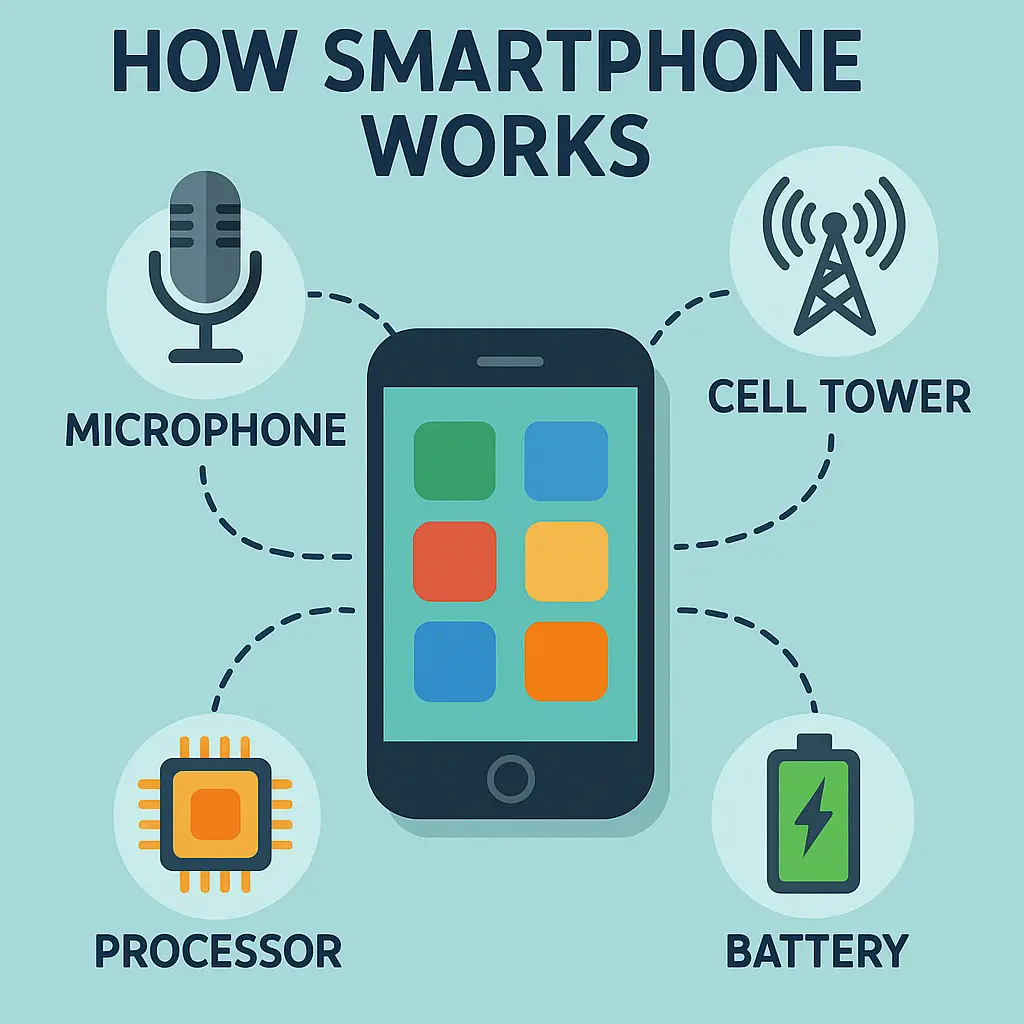
15 Mind-Blowing Facts You Never Knew 📱⚡
Ever wondered how that sleek device in your pocket performs technological miracles every second? Prepare to have your mind blown by the incredible science powering your smartphone!
Your smartphone isn’t just a communication device – it’s a marvel of modern engineering that would seem like pure magic to scientists from just a few decades ago. From transforming sand into computer chips to capturing light and converting it into digital memories, the science behind smartphones is absolutely fascinating. Let’s dive deep into the incredible world of smartphone technology and uncover 15 mind-blowing facts that will change how you look at your device forever! 🤯
1. Your Phone Is Made From Sand – Literally! 🏖️
The Silicon Magic That Powers Everything
The most mind-blowing fact about your smartphone? The brain of your device – the processor – is essentially made from sand! Silicon, the primary component of beach sand, undergoes an incredible transformation to become the foundation of all modern electronics.
The process begins with ultra-pure silicon crystals that are grown in massive furnaces at temperatures exceeding 1,400°C (2,552°F). These crystals are then sliced into paper-thin wafers, each containing hundreds of future processors. Through a process called photolithography, engineers use ultraviolet light to etch billions of microscopic transistors onto these silicon wafers.
What makes this even more incredible is the scale we’re talking about. Modern smartphone processors contain over 15 billion transistors, each smaller than a virus! If you could shrink down to the size of a transistor, the processor would appear larger than a city. This silicon-based technology is so advanced that the manufacturing process requires cleanrooms 10,000 times cleaner than a hospital operating room.
The journey from sand to smartphone processor represents one of humanity’s greatest technological achievements, transforming one of Earth’s most abundant materials into the most sophisticated computing devices ever created.
2. Your Touchscreen Reads Your Body’s Electrical Field ⚡
The Capacitive Technology That Responds to Your Touch
Every time you swipe, tap, or pinch your smartphone screen, you’re witnessing a fascinating interaction between your body’s electrical field and advanced capacitive technology. Your touchscreen doesn’t actually detect physical pressure – instead, it reads the electrical properties of your fingers!
Modern smartphone screens are covered with a transparent grid of electrical conductors, typically made from indium tin oxide (ITO). These conductors create an electrostatic field across the screen surface. When your finger approaches the screen, it acts as a conductor, disrupting this electrical field and creating a capacitive coupling.
The screen’s controller measures these tiny electrical changes across thousands of sensing points, calculating exactly where your finger touched within milliseconds. This is why your phone won’t respond to a stylus (unless it’s specifically designed for capacitive screens) but will work perfectly with any part of your body.
The sensitivity is so precise that modern touchscreens can detect the difference between a light tap and a firm press, enabling features like Force Touch or 3D Touch. The technology can even distinguish between different fingers and detect up to 10 simultaneous touch points, making complex gestures and multi-finger interactions possible.
3. Your Phone Battery Is a Chemistry Lab in Your Pocket 🔬
The Lithium-Ion Science That Keeps You Connected
The battery powering your smartphone is essentially a portable chemistry laboratory performing thousands of controlled chemical reactions every day. Lithium-ion batteries work through a fascinating process called intercalation, where lithium ions shuttle back and forth between two electrodes.
During charging, lithium ions move from the positive electrode (cathode) made of lithium metal oxides to the negative electrode (anode) typically made of graphite. When you use your phone, this process reverses, with ions flowing back to the cathode while releasing electrical energy. The electrolyte solution between the electrodes acts as a highway for these ions.
What makes this process truly remarkable is its efficiency and reversibility. A high-quality smartphone battery can undergo this charging cycle over 1,000 times while retaining 80% of its original capacity. The energy density is so high that a typical smartphone battery stores enough energy to power a small LED light for over 1,000 hours!
However, this chemistry has limitations. Lithium-ion batteries are sensitive to temperature extremes, which is why your phone’s battery drains faster in cold weather and why it can be damaged by excessive heat. Scientists are constantly working on next-generation battery technologies, including solid-state batteries that could triple current energy density while improving safety.
4. Your Camera Captures Light Using Quantum Physics 📸
The Photoelectric Effect in Your Pocket
Every photo you take with your smartphone relies on the photoelectric effect – the same quantum mechanical principle that earned Albert Einstein his Nobel Prize. When light hits your camera sensor, it doesn’t just bounce off; it actually converts photons into electrons through quantum interactions.
Your smartphone camera sensor contains millions of tiny photosites, each acting as a microscopic solar panel. When photons strike these silicon-based sensors, they knock electrons free from their atoms, creating an electrical current proportional to the light intensity. This is pure quantum physics in action!
Modern flagship smartphones pack sensors with over 100 million photosites (pixels) into an area smaller than your fingernail. Each photosite is incredibly small – typically around 1.0 micrometers in diameter, which is about 1/70th the width of a human hair. The precision required to manufacture these sensors is so extreme that a single speck of dust during production could ruin an entire sensor.
The software processing that happens after light capture is equally impressive. Your phone’s AI algorithms analyze the raw sensor data, adjusting colors, reducing noise, and even combining multiple exposures to create the final image. This computational photography means your smartphone can often outperform professional cameras from just a few years ago.
5. Your Phone Connects to Satellites 20,000 km Above Earth 🛰️
The GPS Science That Knows Your Exact Location
One of the most mind-blowing capabilities of your smartphone is its ability to determine your exact location using signals from satellites orbiting Earth at altitudes of over 20,000 kilometers. The Global Positioning System (GPS) represents one of humanity’s most precise technological achievements.
GPS works on the principle of trilateration, requiring signals from at least four satellites to pinpoint your location. Each GPS satellite continuously broadcasts its position and the exact time (using atomic clocks accurate to within nanoseconds). Your phone measures how long these signals take to arrive, calculating your distance from each satellite.
The precision involved is staggering. GPS signals travel at the speed of light, so even tiny timing errors translate to significant location errors. This is why GPS satellites use atomic clocks that are accurate to within one second every 100,000 years. Additionally, Einstein’s theory of relativity actually affects GPS accuracy – the satellites’ clocks run slightly faster due to weaker gravitational fields and time dilation effects.
Your smartphone can typically determine your location to within 3-5 meters under ideal conditions, and newer phones using multiple satellite constellations (GPS, GLONASS, Galileo, and BeiDou) can achieve even better accuracy. The entire system processes over 1 billion location requests daily, making it one of the most heavily used scientific instruments in human history.
6. Your Display Uses Millions of Organic Light-Emitting Diodes 🌈
The OLED Technology That Creates Perfect Blacks
If your smartphone has an OLED display, you’re looking at millions of organic compounds that emit light when electricity passes through them. This isn’t just LED technology – it’s organic chemistry creating the images you see every day.
OLED (Organic Light-Emitting Diode) displays work by applying electrical current to thin films of organic compounds. These carbon-based molecules emit light of different colors when energized, eliminating the need for a backlight. Each pixel contains sub-pixels of red, green, and blue organic materials that can be individually controlled.
The “organic” in OLED refers to carbon-based molecules, not biological materials. These molecules are deposited onto the display substrate using techniques like thermal evaporation in ultra-high vacuum conditions. The precision required is incredible – the organic layers are typically only 100-200 nanometers thick, about 1,000 times thinner than human hair.
This technology enables true black pixels by completely turning off individual diodes, resulting in infinite contrast ratios. OLED displays can also be made flexible because they don’t require rigid backlighting systems, enabling curved screens and potentially foldable displays. The efficiency is remarkable too – OLED pixels only consume power when displaying bright colors, making them more energy-efficient than traditional LCD displays when showing dark content.
7. Your Processor Executes Billions of Instructions Per Second 🚀
The Quantum-Scale Engineering Inside Your Phone
The processor in your smartphone is arguably the most complex device ever created by humans. Modern smartphone processors contain over 15 billion transistors, each switching on and off billions of times per second to execute your commands.
These processors are manufactured using a process called “7-nanometer” or “5-nanometer” technology, referring to the size of the smallest features etched into the silicon. To put this in perspective, these features are so small that you could fit over 10,000 of them across the width of a human hair. At these scales, quantum effects become significant, and engineers must account for individual atoms when designing circuits.
The manufacturing process is incredibly precise. The silicon wafers are processed in cleanrooms where even a single particle of dust could destroy an entire chip. Extreme ultraviolet (EUV) lithography uses light with wavelengths of 13.5 nanometers to etch these microscopic patterns – this light is so energetic that it requires special mirrors and must be used in a vacuum.
Modern smartphone processors can execute over 100 billion instructions per second while consuming less power than a small light bulb. They contain specialized cores for different tasks: CPU cores for general processing, GPU cores for graphics, AI accelerators for machine learning, and digital signal processors for handling communications. This parallel processing architecture enables your phone to simultaneously run multiple apps, process camera images, maintain network connections, and respond to your touch inputs.
8. Your Phone’s Memory Is a Maze of Electrons 🧠
The Flash Storage That Remembers Everything
Your smartphone’s storage uses a technology called NAND flash memory, which stores your photos, apps, and data by trapping electrons in microscopic cages. This isn’t magnetic storage like old hard drives – it’s pure electronic engineering at the quantum level.
Flash memory works by using floating gates – tiny conducting islands surrounded by insulating material. To store a bit of data, electrons are forced through this insulation using a process called quantum tunneling. Once trapped, these electrons can remain in place for decades, even without power.
Modern smartphones use 3D NAND technology, where memory cells are stacked vertically in layers up to 176 levels high. If you could see inside your phone’s storage chip, it would look like a microscopic skyscraper with billions of floors, each containing millions of electron traps.
The speed of modern flash storage is remarkable. High-end smartphones can read data at speeds exceeding 3,000 MB/s – fast enough to transfer a feature-length movie in under 2 seconds. The endurance is equally impressive, with modern flash memory capable of withstanding over 100,000 program-erase cycles per cell.
What makes this technology even more incredible is its reliability. Your phone’s storage uses sophisticated error correction algorithms that can detect and fix bit errors, ensuring your data remains intact even as individual memory cells begin to wear out.
9. Your Phone Antenna Is a Masterpiece of Electromagnetic Engineering 📡
The Science of Wireless Communication
Your smartphone contains multiple antennas designed to capture and transmit electromagnetic waves across different frequency bands. These antennas are marvels of engineering, each optimized for specific types of communication.
The main cellular antenna in your phone is designed to work across multiple frequency bands, from 700 MHz to over 3 GHz. The length and shape of these antennas are precisely calculated based on the wavelength of the signals they need to handle. For example, a 2.4 GHz WiFi antenna needs to be approximately 3.1 centimeters long to achieve optimal resonance.
Modern smartphones use advanced antenna technologies like MIMO (Multiple Input, Multiple Output), which employs multiple antennas working together to increase data rates and improve signal reliability. Some high-end phones have over 20 different antennas for various functions: cellular, WiFi, Bluetooth, GPS, and Near Field Communication (NFC).
The engineering challenges are immense. Antennas must work efficiently while being surrounded by metal components, batteries, and other electronic devices that can interfere with radio signals. Engineers use sophisticated computer modeling to optimize antenna placement and design, often creating antennas that are integrated into the phone’s metal frame itself.
5G technology has made antenna design even more complex, with some phones using beamforming antennas that can electronically steer radio waves in specific directions, improving signal strength and reducing interference.
10. Your Phone Screen Refreshes Faster Than Your Eye Can See 👁️
The High-Refresh Display Technology
Modern smartphones feature displays that refresh at rates of 120Hz, 144Hz, or even higher, meaning the screen updates its image 120 to 144 times per second. This is far faster than the human eye typically notices, but the effect on user experience is profound.
The technology behind high-refresh displays involves incredibly precise timing. The display controller must coordinate with the graphics processor to deliver new frames at exact intervals. A 120Hz display has just 8.33 milliseconds to render each frame, requiring enormous computational power and efficient power management.
Variable refresh rate technology makes this even more sophisticated. Your phone can dynamically adjust the refresh rate based on content – dropping to 1Hz for static images to save battery, then ramping up to 120Hz for smooth scrolling or gaming. This adaptive refresh rate can reduce power consumption by up to 20% while maintaining smooth performance.
The benefits extend beyond just smooth scrolling. Higher refresh rates reduce motion blur, improve touch responsiveness, and create a more natural feeling when interacting with your device. The reduced input lag (the time between touching the screen and seeing a response) can be as little as 20 milliseconds on high-end devices.
11. Your Phone Uses AI Chips That Mimic Brain Functions 🧠
Neural Processing Units in Your Pocket
Modern smartphones contain specialized AI chips called Neural Processing Units (NPUs) that are designed to mimic the way human brains process information. These chips use a fundamentally different architecture than traditional processors, optimized for the parallel processing required by artificial intelligence.
NPUs are designed around the concept of artificial neural networks, with thousands of simple processing elements that work together to recognize patterns, process images, and make decisions. Unlike traditional processors that handle tasks sequentially, NPUs can process millions of data points simultaneously.
The applications are remarkable. Your phone’s NPU enables real-time language translation, advanced photography features like portrait mode and night vision, voice recognition, and predictive text input. These chips can perform over 15 trillion operations per second while consuming less power than a traditional processor handling the same AI tasks.
The efficiency comes from specialized hardware optimized for matrix multiplication – the fundamental mathematical operation in neural networks. NPUs use techniques like quantization and pruning to reduce the computational requirements while maintaining accuracy, enabling complex AI models to run locally on your device without requiring cloud processing.
12. Your Phone Battery Charges Using Electromagnetic Induction 🔄
The Wireless Power Transfer Science
Wireless charging in smartphones uses the same electromagnetic principles discovered by Michael Faraday in 1831. When you place your phone on a wireless charger, you’re witnessing electromagnetic induction in action – the transfer of energy through magnetic fields.
The wireless charger contains a coil of wire that creates an alternating magnetic field when connected to power. Your phone contains a matching coil that acts as a receiver. When the magnetic field from the charger passes through the receiver coil, it induces an electrical current that charges your battery.
The efficiency of this process depends on precise alignment and frequency matching. Most wireless chargers operate at 125-205 kHz, and the coils must be aligned within millimeters for optimal power transfer. Modern phones use magnetic alignment systems to ensure proper positioning.
Advanced wireless charging systems can now deliver over 50 watts of power, approaching the speed of wired charging. Some phones support reverse wireless charging, turning your device into a wireless charger for other devices. The technology is evolving toward long-range wireless power transfer, potentially enabling charging from several feet away.
13. Your Phone Camera Uses Computational Photography 📱
AI-Powered Image Processing
Modern smartphone cameras don’t just capture images – they create them using sophisticated computational photography techniques. When you take a photo, your phone often captures multiple exposures, processes them using AI algorithms, and combines them into a single optimized image.
Night mode photography demonstrates this perfectly. Your phone captures multiple frames at different exposure levels, aligns them to compensate for hand movement, and uses AI to reduce noise while preserving detail. The processing happens in real-time, often in under a second.
Portrait mode uses depth-sensing technology combined with AI to identify subjects and create artificial background blur (bokeh). Some phones use multiple cameras to create a depth map, while others use a single camera with AI algorithms trained on millions of images to distinguish between foreground and background.
The computational power required is staggering. Processing a single high-resolution image with HDR, noise reduction, and AI enhancement can involve billions of calculations. Modern phone cameras can analyze scenes in real-time, adjusting settings automatically and even suggesting optimal composition.
14. Your Phone Connects to Cell Towers Using Advanced Modulation 📶
The Science of Cellular Communication
Your smartphone’s ability to communicate with cell towers relies on sophisticated modulation techniques that pack enormous amounts of data into radio waves. Modern 5G networks use advanced modulation schemes that can transmit over 1 gigabit per second of data.
The process begins with digital data being converted into analog radio waves using techniques like Quadrature Amplitude Modulation (QAM). 5G networks use 256-QAM or even 1024-QAM, which can encode 8-10 bits of data per symbol. This is like having a radio signal that can represent over 1,000 different states simultaneously.
Multiple antenna systems (MIMO) enable even higher data rates by using multiple radio streams simultaneously. Your phone can communicate with a cell tower using 4, 8, or even 16 separate data streams, each carrying different information. The phone’s processor must coordinate all these streams in real-time while managing interference and signal quality.
The frequency management is incredibly sophisticated. Your phone can simultaneously connect to multiple frequency bands, aggregate bandwidth from different carriers, and even switch between different cellular technologies (4G, 5G) seamlessly based on signal conditions and data requirements.
15. Your Phone’s Operating System Manages Billions of Operations 💻
The Software Symphony Coordinating Everything
The operating system in your smartphone is one of the most complex software systems ever created, managing billions of operations per second while maintaining a responsive user interface. Every tap, swipe, and app launch involves thousands of individual software components working in perfect harmony.
Modern mobile operating systems use sophisticated scheduling algorithms to manage processor time among hundreds of running processes. The system must balance performance, battery life, and user experience while ensuring that critical functions like phone calls and emergency services always have priority.
Memory management is equally complex. Your phone’s OS uses techniques like compressed memory, intelligent caching, and predictive loading to make limited RAM feel unlimited. The system learns your usage patterns and pre-loads frequently used apps while intelligently managing background processes.
The security implementations are remarkable. Modern phones use hardware-based encryption, secure boot processes, and sandboxing to protect your data. Every app runs in its own secure container, and the system uses machine learning to detect and prevent malicious behavior in real-time.
Conclusion: The Future is Already in Your Hands 🚀
Your smartphone represents the pinnacle of human scientific achievement, combining discoveries from physics, chemistry, materials science, and computer engineering into a device that would have seemed impossible just decades ago. From quantum mechanics enabling your camera to electromagnetic theory powering your wireless connections, every aspect of your phone relies on fundamental scientific principles.
The next generation of smartphone technology promises even more incredible innovations. We’re approaching the development of quantum processors, advanced AI chips that rival human intelligence, holographic displays, and battery technologies that could power your phone for weeks on a single charge.
Understanding the science behind your smartphone not only satisfies curiosity but also helps us appreciate the remarkable human ingenuity that goes into creating these everyday miracles. The device in your pocket truly represents humanity’s greatest technological achievement – a testament to our ability to harness the fundamental forces of nature and transform them into tools that enhance our lives.
The next time you use your smartphone, remember that you’re holding in your hands a device that embodies centuries of scientific discovery and represents the cutting edge of human technological capability. It’s not just a phone – it’s a window into the incredible world of modern science and engineering! 🔬✨
Have you discovered any other fascinating facts about smartphone technology? Share your thoughts and let’s continue exploring the amazing science that powers our digital world!