
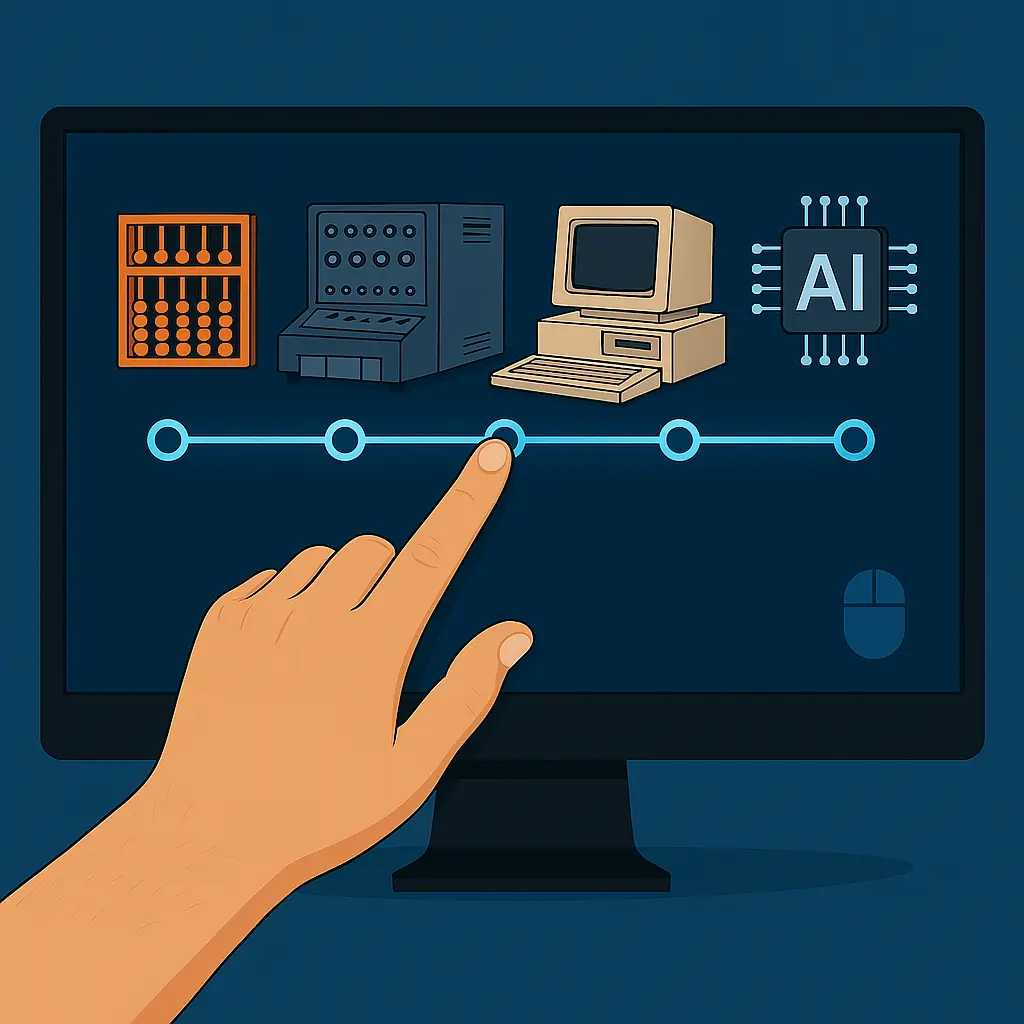
From Abacus to AI (Interactive Timeline) 🖥️
Journey through 5,000 years of computational evolution that shaped our digital world
Computing didn’t begin with Silicon Valley startups or garage inventors. The fascinating history of computing spans millennia, from ancient counting devices to artificial intelligence systems that can engage in human-like conversations. This comprehensive timeline explores how humanity’s quest to process information faster and more efficiently led to the digital revolution that defines our modern world.
The Ancient Foundations (3000 BCE – 1600 CE) 🏛️
The Abacus: Humanity’s First Computer (3000 BCE)
The story begins in ancient Mesopotamia with the abacus – arguably the world’s first computing device. This simple yet revolutionary tool used beads on rods to perform arithmetic calculations, fundamentally changing how humans processed numerical information.
Key Features:
- ⚡ Instant addition and subtraction
- 🌍 Spread across civilizations (China, Rome, Greece)
- 🎯 Still used in many countries today
- 💡 Introduced the concept of positional notation
The Chinese suanpan, Japanese soroban, and Russian schoty all evolved from this foundational concept, proving that great innovations transcend cultural boundaries.
Ancient Analog Computers: The Antikythera Mechanism (100 BCE)
Discovered in a Greek shipwreck, the Antikythera Mechanism represents humanity’s first analog computer. This bronze device could predict:
- 🌙 Lunar phases
- 🌞 Solar eclipses
- 🏛️ Olympic Games dates
- 🌟 Planetary positions
This mechanical marvel demonstrates that ancient civilizations possessed sophisticated understanding of computational principles, centuries before the modern era.
Medieval Innovations: The Astrolabe (800 CE)
Islamic scholars perfected the astrolabe, a handheld computer for astronomical calculations. This device could:
- 🧭 Determine direction and time
- 📍 Calculate prayer times
- 🌍 Measure latitude
- ⭐ Map star positions
The astrolabe influenced navigation, astronomy, and timekeeping across medieval Europe and the Islamic world.
The Mechanical Revolution (1600-1940) ⚙️
The Birth of Mechanical Calculation
The 17th century marked the beginning of mechanical computation with several groundbreaking inventions:
Wilhelm Schickard’s Calculating Clock (1623)
- ✨ First mechanical calculator
- 🔢 Performed basic arithmetic
- 🎯 Influenced later inventors
Blaise Pascal’s Pascaline (1642)
- 🧮 Mechanical adding machine
- 💰 Designed for tax calculations
- 🏗️ Featured carry mechanism
Gottfried Leibniz’s Step Reckoner (1694)
- ➕ Addition and subtraction
- ✖️ Multiplication and division
- 🔄 Introduced stepped drum mechanism
The Visionary: Charles Babbage and the Analytical Engine (1837)
Charles Babbage conceived the Analytical Engine, a mechanical computer that contained all elements of modern computers:
Revolutionary Features:
- 🧠 Mill (CPU): Performed calculations
- 💾 Store (Memory): Held numbers and instructions
- 📝 Programming: Used punched cards
- 🔄 Loops: Conditional branching
- 📊 Output: Printed results
Though never completed due to technological limitations, Babbage’s design included:
- 🎯 Input/output mechanisms
- 🔢 Arithmetic logic unit
- 📋 Control unit
- 💿 Memory storage
Ada Lovelace: The First Programmer (1843)
Ada Lovelace wrote the first computer program – an algorithm for calculating Bernoulli numbers on Babbage’s Analytical Engine. Her contributions include:
- 📝 First computer program
- 🎵 Envisioned computers creating music
- 🔮 Predicted computers beyond pure calculation
- 👩💻 Became the first programmer in history
Lovelace’s notes contained the first published algorithm specifically tailored for implementation on a computer, making her the world’s first computer programmer.
The Jacquard Loom: Programming with Punch Cards (1804)
Joseph Marie Jacquard revolutionized textile manufacturing with his programmable loom:
- 🧵 Automated complex weaving patterns
- 📇 Used punched cards for instructions
- 🏭 Inspired later computer input methods
- 🔄 Demonstrated programmable automation
This innovation directly influenced Herman Hollerith’s tabulating machine, used in the 1890 U.S. Census.
The Electronic Age Begins (1940-1970) 💡
World War II and the Birth of Electronic Computing
The urgent computational needs of World War II accelerated computer development:
Colossus (1943)
- 🔐 British codebreaking computer
- ⚡ Used vacuum tubes
- 🎯 Cracked German Enigma codes
- 🏆 Shortened the war by years
ENIAC (1946)
- 🏢 Scale: Room-sized (30 tons, 18,000 vacuum tubes)
- ⚡ Speed: 1,000 times faster than mechanical computers
- 🔢 Purpose: Ballistic calculations
- 👥 Operators: Programmed by women mathematicians
Key ENIAC Statistics:
- 📏 Dimensions: 30 x 50 feet
- ⚡ Power: 150 kilowatts
- 🔥 Heat: Required constant cooling
- 🐛 Reliability: Vacuum tubes failed frequently
The Stored Program Concept
John von Neumann introduced the revolutionary concept of storing programs in memory alongside data:
Von Neumann Architecture:
- 🧠 CPU processes instructions
- 💾 Memory stores programs and data
- 🔄 Instructions executed sequentially
- 📊 Common bus for data transfer
This architecture remains fundamental to modern computers.
First Generation Computers (1940-1956)
Characteristics:
- 🔥 Vacuum tube technology
- 🏢 Room-sized installations
- 💰 Extremely expensive
- 🎯 Limited to scientific calculations
Notable Machines:
- UNIVAC I (1951): Predicted Eisenhower’s election victory
- IBM 701 (1952): First commercial computer
- EDVAC (1949): Implemented stored program concept
The Transistor Revolution (1947)
Bell Labs invented the transistor, earning John Bardeen, Walter Brattain, and William Shockley the Nobel Prize:
Transistor Advantages:
- 🔋 Lower power consumption
- 🏃♂️ Faster switching
- 🔧 More reliable
- 📏 Smaller size
- 💰 Lower cost
This invention launched the Second Generation of computers (1956-1963).
The Silicon Revolution (1970-1990) 🖥️
The Integrated Circuit Era
Jack Kilby (Texas Instruments) and Robert Noyce (Intel) independently invented the integrated circuit in 1958:
Revolutionary Impact:
- 🔬 Thousands of transistors on one chip
- 📉 Dramatically reduced size and cost
- 📈 Increased performance and reliability
- 🚀 Enabled miniaturization
The Microprocessor: Intel 4004 (1971)
Intel’s 4004 became the world’s first microprocessor:
Specifications:
- 🔢 4-bit architecture
- 🎯 2,300 transistors
- ⚡ 740 kHz clock speed
- 💰 Cost: $200
This revolutionary chip could perform calculations that previously required room-sized computers.
The Personal Computer Revolution
Altair 8800 (1975)
- 💻 First personal computer kit
- 🎯 Intel 8080 processor
- 💾 256 bytes of memory
- 📺 No keyboard or monitor
Apple II (1977)
- 🍎 Founders: Steve Jobs and Steve Wozniak
- 🎨 Color graphics capability
- 🔊 Built-in sound
- 💾 Floppy disk storage
- 📈 Mass market appeal
IBM PC (1981)
- 🏢 Legitimized personal computers
- 🖥️ Intel 8088 processor
- 📀 MS-DOS operating system
- 🔄 Open architecture
The Software Revolution
Operating Systems:
- 🐧 UNIX (1969): Multitasking, multiuser
- 🖥️ MS-DOS (1981): Disk operating system
- 🍎 Mac OS (1984): Graphical user interface
- 🪟 Windows (1985): GUI for PCs
Programming Languages:
- 🅱️ BASIC: Beginner-friendly
- 🅲 C: System programming
- 🐍 Pascal: Structured programming
- ☕ Java: Platform independent
The Internet Age (1990-2005) 🌐
ARPANET: The Internet’s Foundation (1969)
The Advanced Research Projects Agency Network connected four universities:
- 🏫 UCLA
- 🏫 Stanford
- 🏫 UC Santa Barbara
- 🏫 University of Utah
Key Innovations:
- 📦 Packet switching
- 🔗 TCP/IP protocol
- 📧 Email communication
- 🌐 Distributed network
The World Wide Web (1989)
Tim Berners-Lee at CERN invented the World Wide Web:
Core Technologies:
- 🔗 HTML: Markup language
- 🌐 HTTP: Transfer protocol
- 🔍 URLs: Web addresses
- 💻 Web browsers: Information access
First Website: info.cern.ch (1991)
The Browser Wars
Mosaic (1993)
- 🖼️ First graphical web browser
- 📸 Displayed images inline
- 🚀 Made web user-friendly
Netscape Navigator (1994)
- 🌟 Dominated early web
- 📈 IPO sparked dot-com boom
- 💡 Introduced JavaScript
Internet Explorer (1995)
- 🖥️ Bundled with Windows
- 🏆 Won browser wars
- 📊 Achieved 95% market share
The Dot-Com Boom (1995-2000)
Revolutionary Companies:
- 🛒 Amazon (1994): Online bookstore
- 🔍 Yahoo (1994): Web directory
- 🎯 eBay (1995): Online auctions
- 🔎 Google (1998): Search engine
Key Developments:
- 💰 Venture capital influx
- 📈 Stock market surge
- 🌟 E-commerce emergence
- 💥 Bubble burst (2000)
The Rise of Open Source
Linux (1991)
- 🐧 Creator: Linus Torvalds
- 🔓 Open source operating system
- 🌐 Internet development platform
- 🏢 Enterprise adoption
Apache Web Server (1995)
- 🌐 Powered early web
- 🔓 Open source model
- 📊 Dominated web servers
- 🤝 Community development
The Mobile Revolution (2005-2015) 📱
The Smartphone Era
BlackBerry (2003)
- 📧 Mobile email pioneer
- ⌨️ Physical keyboard
- 🔒 Business security
- 📈 Professional adoption
iPhone (2007)
- 🍎 Revolution: Touch interface
- 📱 App ecosystem
- 🌐 Internet in pocket
- 🎵 iPod integration
Android (2008)
- 🤖 Google’s platform
- 🔓 Open source
- 🏢 Multiple manufacturers
- 📊 Market dominance
The App Economy
App Store (2008)
- 💰 New revenue model
- 👨💻 Developer ecosystem
- 📱 Software distribution
- 🌟 Mobile-first design
Revolutionary Apps:
- 🗺️ Maps: GPS navigation
- 📸 Instagram: Photo sharing
- 💬 WhatsApp: Messaging
- 🚗 Uber: Ride sharing
Tablet Computing
iPad (2010)
- 📱 Tablet renaissance
- 🎨 Creative applications
- 📚 Digital publishing
- 🏫 Educational adoption
Cloud Computing Revolution
Key Platforms:
- ☁️ AWS (2006): Infrastructure as a Service
- 📊 Google Cloud: Big data processing
- 💻 Microsoft Azure: Enterprise solutions
- 📦 Dropbox: File synchronization
Benefits:
- 💰 Reduced costs
- 📈 Scalability
- 🌐 Global accessibility
- 🔄 Automatic updates
The AI Renaissance (2015-Present) 🤖
Machine Learning Breakthrough
Deep Learning Revolution:
- 🧠 Neural networks
- 🖼️ Image recognition
- 🗣️ Speech processing
- 🔍 Pattern recognition
Key Milestones:
- 🏆 AlexNet (2012): ImageNet victory
- 🎯 AlphaGo (2016): Beat world champion
- 🚗 Tesla Autopilot: Self-driving cars
- 🗣️ Siri/Alexa: Voice assistants
The Transformer Era
GPT Evolution:
- 🤖 GPT-1 (2018): Language understanding
- 📝 GPT-2 (2019): Text generation
- 🎯 GPT-3 (2020): Human-like responses
- 🌟 ChatGPT (2022): Conversational AI
Revolutionary Applications:
- ✍️ Content creation
- 👨💻 Code generation
- 🎨 Art and design
- 🔬 Scientific research
Big Data and Analytics
Data Processing:
- 📊 Hadoop: Distributed computing
- ⚡ Spark: Real-time processing
- 🔍 Elasticsearch: Search analytics
- 📈 Tableau: Data visualization
Applications:
- 🛒 Personalized recommendations
- 🎯 Targeted advertising
- 🏥 Medical diagnosis
- 💰 Financial analysis
Quantum Computing Dawn
Leading Companies:
- 🔬 IBM: Quantum processors
- 🌐 Google: Quantum supremacy
- 🏢 Microsoft: Quantum development
- 🚀 IonQ: Trapped ion systems
Potential Applications:
- 🔐 Cryptography
- 💊 Drug discovery
- 🌤️ Weather prediction
- 🔬 Materials science
The Future of Computing (2025-2050) 🚀
Emerging Technologies
Biological Computing:
- 🧬 DNA storage systems
- 🦠 Living computers
- 🧠 Brain-computer interfaces
- 🌱 Organic processors
Optical Computing:
- 💡 Light-based processing
- ⚡ Quantum communication
- 🔬 Photonic circuits
- 🌟 Holographic storage
Neuromorphic Computing:
- 🧠 Brain-inspired chips
- 🔋 Ultra-low power
- 🎯 Pattern recognition
- 🤖 Autonomous systems
Revolutionary Applications
Metaverse Computing:
- 🥽 Virtual reality worlds
- 🌐 Persistent digital spaces
- 💰 Virtual economies
- 🤝 Social interaction
Autonomous Everything:
- 🚗 Self-driving vehicles
- 🏭 Automated factories
- 🏠 Smart homes
- 🌆 Intelligent cities
Personalized AI:
- 🎯 Individual assistants
- 📚 Customized learning
- 🏥 Precision medicine
- 💼 Career guidance
Key Innovators Who Shaped Computing 👥
Pioneers and Visionaries
Alan Turing (1912-1954)
- 🧠 Theoretical computer science
- 🔐 Codebreaking genius
- 🤖 Artificial intelligence concepts
- 📏 Turing machine model
Grace Hopper (1906-1992)
- 💻 First computer programmer
- 🐛 “Debugging” terminology
- 📝 COBOL language development
- 🏢 Computer language standardization
John von Neumann (1903-1957)
- 🏗️ Computer architecture
- 🧮 Mathematical foundations
- 🔬 Scientific computing
- 💡 Stored program concept
Modern Tech Leaders
Steve Jobs (1955-2011)
- 🍎 Apple co-founder
- 🎨 Design revolutionary
- 📱 iPhone creator
- 💻 Personal computer pioneer
Bill Gates (1955-)
- 🪟 Microsoft founder
- 💻 PC software dominance
- 🌐 Internet adoption
- 💰 Technology philanthropy
Tim Berners-Lee (1955-)
- 🌐 World Wide Web inventor
- 🔗 HTTP protocol creator
- 📝 HTML markup language
- 🌍 Open web advocacy
The Computing Impact on Society 🌍
Economic Transformation
Industry Revolution:
- 🏭 Manufacturing automation
- 💰 Financial services digitization
- 🛒 E-commerce emergence
- 📊 Data-driven decisions
Job Market Evolution:
- 👨💻 New career paths
- 🤖 Automation displacement
- 📚 Continuous learning need
- 🌐 Remote work possibilities
Social and Cultural Changes
Communication Revolution:
- 📱 Instant global connection
- 🌐 Social media platforms
- 💬 Digital communities
- 🎥 Video conferencing
Knowledge Democratization:
- 🔍 Information accessibility
- 📚 Online education
- 🌐 Global learning
- 📖 Digital libraries
Challenges and Opportunities
Privacy and Security:
- 🔒 Data protection
- 🛡️ Cybersecurity threats
- 🔐 Encryption importance
- ⚖️ Regulatory frameworks
Digital Divide:
- 🌍 Global access inequality
- 💰 Economic barriers
- 📚 Educational gaps
- 🏘️ Rural connectivity
Computing Timeline: Major Milestones 📅
Ancient Era (3000 BCE – 1600 CE)
- 3000 BCE: Abacus invented
- 100 BCE: Antikythera mechanism
- 800 CE: Astrolabe perfected
- 1614: Logarithms developed
Mechanical Era (1600-1940)
- 1623: Schickard’s calculator
- 1642: Pascal’s Pascaline
- 1804: Jacquard loom
- 1837: Babbage’s Analytical Engine
Electronic Era (1940-1970)
- 1943: Colossus computer
- 1946: ENIAC completed
- 1947: Transistor invented
- 1969: ARPANET launched
Personal Computer Era (1970-1990)
- 1971: Intel 4004 microprocessor
- 1975: Altair 8800
- 1977: Apple II
- 1981: IBM PC
Internet Era (1990-2005)
- 1989: World Wide Web
- 1993: Mosaic browser
- 1995: Windows 95
- 1998: Google founded
Mobile Era (2005-2015)
- 2007: iPhone launched
- 2008: Android released
- 2010: iPad introduced
- 2012: Instagram acquired
AI Era (2015-Present)
- 2016: AlphaGo victory
- 2018: GPT-1 released
- 2022: ChatGPT launched
- 2023: AI mainstream adoption
The Continuing Evolution 🔄
Computing history demonstrates humanity’s relentless pursuit of better tools for processing information. From the simple abacus to sophisticated AI systems, each innovation built upon previous discoveries, creating an exponential progression of computational power.
The journey from room-sized vacuum tube computers to pocket-sized smartphones represents more than technological advancement – it reflects our evolving relationship with information, communication, and problem-solving. Today’s AI systems can engage in conversations, create art, and solve complex problems, yet they represent just another step in computing’s continuous evolution.
As we stand on the threshold of quantum computing, biological processors, and artificial general intelligence, the next chapters of computing history promise to be even more remarkable. The story that began with counting beads on an abacus continues to unfold, shaping our future in ways we can barely imagine.
The complete history of computing reveals not just technological progress, but the human spirit’s endless quest to augment our capabilities and understand our world. From ancient mathematicians to modern AI researchers, each generation has pushed the boundaries of what’s computationally possible, creating the digital foundation upon which our modern civilization depends.
This remarkable journey from abacus to AI demonstrates that the history of computing is ultimately the history of human ingenuity, creativity, and our endless desire to build tools that help us think, create, and connect more effectively. The story continues, and the next chapter is being written today.