
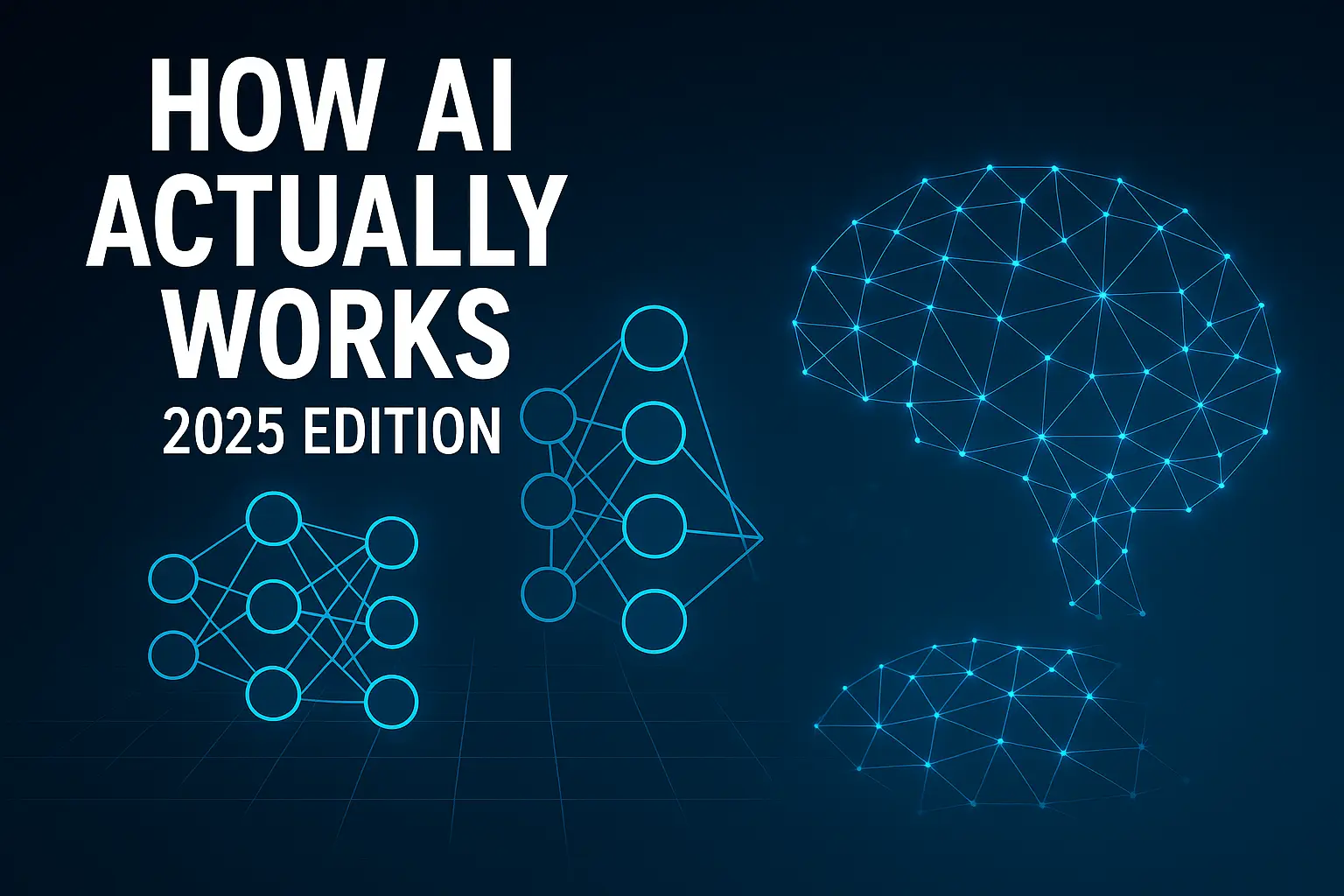
The Complete Guide From Beginner to Expert (2025 Edition) 🤖
Last updated: July 2025
Artificial Intelligence isn’t magic—it’s mathematics, patterns, and clever programming working together to solve problems. Whether you’re a curious beginner or someone looking to deepen your understanding, this comprehensive guide will take you from AI basics to advanced concepts, all explained in plain English.
What Is Artificial Intelligence Really? 🧠
Artificial Intelligence (AI) is the science of making machines perform tasks that typically require human intelligence. Think of it as teaching computers to recognize patterns, make decisions, and solve problems—just like humans do, but using different methods.
The Simple Definition That Actually Makes Sense
Imagine you’re teaching a child to recognize cats in photos. You’d show them hundreds of cat pictures, pointing out features like whiskers, pointy ears, and fur patterns. Eventually, they’d learn to identify cats on their own.
AI works similarly, but instead of a child, we’re training computer programs using massive amounts of data. The “learning” happens through mathematical algorithms that identify patterns and make predictions.
Why AI Matters More Than Ever in 2025 📈
AI has moved from science fiction to daily reality. Right now, AI is:
- Powering your smartphone 📱 (voice assistants, camera features, predictive text)
- Curating your social media 📸 (what posts you see, friend suggestions)
- Driving recommendations 🎬 (Netflix shows, Amazon products, Spotify playlists)
- Revolutionizing healthcare 🏥 (diagnostic imaging, drug discovery, personalized treatment)
- Transforming transportation 🚗 (self-driving cars, traffic optimization, route planning)
The Three Types of AI Explained 🔍
Understanding AI types helps clarify what’s possible today versus what’s coming tomorrow.
1. Narrow AI (Artificial Narrow Intelligence) 🎯
What it is: AI designed for specific tasks—extremely good at one thing but useless at everything else.
Real-world examples:
- Netflix recommendation engine knows what movies you’ll enjoy but can’t drive a car
- Google Translate converts languages brilliantly but can’t play chess
- Tesla Autopilot handles highway driving but can’t write emails
Why it dominates 2025: Every AI system you interact with today is Narrow AI. It’s reliable, measurable, and solves real problems.
2. General AI (Artificial General Intelligence) 🌟
What it is: AI that matches human cognitive abilities across all domains—thinking, reasoning, learning, and adapting like humans.
Current status: Doesn’t exist yet. Leading AI researchers predict it might arrive between 2030-2050, though timelines vary wildly.
What it would mean: An AI that could seamlessly switch between writing poetry, solving physics problems, having emotional conversations, and learning new skills—just like humans.
3. Super AI (Artificial Super Intelligence) 🚀
What it is: AI that surpasses human intelligence in every domain—essentially becoming smarter than the smartest humans.
Current status: Purely theoretical. Most experts consider this the most distant possibility, potentially decades after achieving General AI.
The big question: Would Super AI be humanity’s greatest achievement or greatest risk?
How Neural Networks Actually Work 🧮
Neural networks are the backbone of modern AI. Let’s break down this complex topic into digestible pieces.
The Human Brain Inspiration 🧠
Your brain contains roughly 86 billion neurons connected by trillions of synapses. When you see a dog, electrical signals race between neurons, creating the recognition pattern for “dog.”
Artificial neural networks mimic this process using mathematical functions instead of biological neurons.
Artificial Neurons: The Building Blocks ⚙️
An artificial neuron receives inputs, processes them, and produces an output. Here’s the simplified process:
- Input Reception 📥: Receives numerical data (like pixel values from an image)
- Weight Application ⚖️: Each input gets multiplied by a “weight” (importance factor)
- Summation ➕: All weighted inputs get added together
- Activation 🔥: The sum passes through an “activation function” to produce the final output
Network Architecture: Layers Upon Layers 📚
Modern neural networks contain multiple layers:
Input Layer: Receives raw data (image pixels, text, sensor readings)
Hidden Layers: The magic happens here—patterns get detected and refined through multiple processing stages
Output Layer: Produces final results (classifications, predictions, decisions)
Real Example: Image Recognition 📸
When you upload a photo to Facebook and it suggests tagging friends:
- Input Layer receives pixel values from the image
- Hidden Layers detect edges, shapes, facial features, and finally complete faces
- Output Layer identifies specific people based on learned patterns
Machine Learning: The Engine Behind AI 🚂
Machine Learning (ML) is how AI systems actually learn from data. It’s the difference between programming specific rules and letting computers discover patterns themselves.
Traditional Programming vs Machine Learning 🔄
Traditional Programming:
- Input: Data + Rules
- Output: Answers
- Example: “If temperature > 80°F, recommend shorts”
Machine Learning:
- Input: Data + Answers
- Output: Rules (patterns)
- Example: Show weather data and clothing choices, let AI discover the relationship
The Three Main Types of Machine Learning 📊
1. Supervised Learning 👨🏫
How it works: Learning with a teacher—you show the AI examples with correct answers.
Process:
- Training Phase: Feed thousands of examples (photos labeled “cat” or “dog”)
- Pattern Recognition: AI identifies distinguishing features
- Testing Phase: Present unlabeled examples to check accuracy
- Deployment: Use the trained model on new, real-world data
Common Applications:
- Email spam detection 📧 (trained on millions of spam/legitimate emails)
- Medical diagnosis 🩺 (trained on thousands of medical scans with known diagnoses)
- Credit scoring 💳 (trained on historical loan data and outcomes)
2. Unsupervised Learning 🔍
How it works: Learning without a teacher—AI finds hidden patterns in unlabeled data.
Key Techniques:
- Clustering: Grouping similar items together
- Dimensionality Reduction: Simplifying complex data while preserving important patterns
- Association Rules: Finding relationships between different items
Real-World Applications:
- Customer Segmentation 🛍️ (grouping customers by purchasing behavior)
- Anomaly Detection 🚨 (identifying unusual patterns in network traffic)
- Recommendation Systems 🎵 (discovering music preferences without explicit ratings)
3. Reinforcement Learning 🎮
How it works: Learning through trial and error—AI agents take actions and receive rewards or penalties.
The Process:
- Agent (AI system) observes the environment
- Takes Action based on current strategy
- Receives Reward or penalty for the action
- Updates Strategy to maximize future rewards
Breakthrough Applications:
- Game Playing 🎯 (AlphaGo, chess engines, video game bots)
- Autonomous Vehicles 🚗 (learning optimal driving strategies)
- Trading Algorithms 📈 (optimizing investment strategies)
Deep Learning: The AI Revolution 🌊
Deep Learning represents the cutting edge of AI, using complex neural networks with many layers to solve previously impossible problems.
What Makes Deep Learning Special? ✨
Automatic Feature Detection: Traditional ML required humans to identify important features. Deep learning discovers these features automatically.
Example: In image recognition:
- Traditional ML: Programmers manually coded rules for detecting edges, corners, and shapes
- Deep Learning: Networks automatically learn to detect these features and much more complex patterns
Popular Deep Learning Architectures 🏗️
Convolutional Neural Networks (CNNs) 📷
Best for: Image and video processing
How they work: Use mathematical “filters” to detect features like edges, textures, and objects across different positions in images.
Applications:
- Medical Imaging 🏥 (detecting tumors in X-rays)
- Autonomous Vehicles 🚗 (recognizing traffic signs, pedestrians, other vehicles)
- Quality Control 🏭 (identifying defects in manufacturing)
Recurrent Neural Networks (RNNs) 🔄
Best for: Sequential data like text, speech, and time series
How they work: Have “memory” that allows them to use information from previous inputs when processing current inputs.
Applications:
- Language Translation 🌍 (Google Translate, DeepL)
- Speech Recognition 🎤 (Siri, Alexa, Google Assistant)
- Stock Market Prediction 📈 (analyzing historical price patterns)
Transformer Models 🔄
Best for: Natural language processing and understanding
How they work: Use “attention mechanisms” to focus on relevant parts of input when generating outputs.
Applications:
- ChatGPT and GPT models 💬 (conversational AI)
- Google Search 🔍 (understanding search queries)
- Code Generation 💻 (GitHub Copilot, automated programming)
AI in Your Daily Life: Real-World Applications 🌍
AI isn’t just a future concept—it’s actively improving your daily experiences right now.
Social Media and Entertainment 📱
News Feed Curation: Facebook’s algorithm analyzes your behavior to show relevant posts, balancing friend updates, news, and advertisements.
Video Recommendations: YouTube’s AI processes your viewing history, search queries, and engagement patterns to suggest videos you’ll actually want to watch.
Content Moderation: AI systems automatically detect and remove harmful content, spam, and inappropriate material across platforms.
E-commerce and Shopping 🛒
Product Recommendations: Amazon’s recommendation engine drives 35% of their sales by suggesting products based on your browsing history, purchases, and similar customer behavior.
Dynamic Pricing: Airlines, hotels, and ride-sharing services use AI to adjust prices based on demand, competition, and user behavior.
Fraud Detection: Credit card companies use AI to identify suspicious transactions in real-time, protecting your financial security.
Transportation and Navigation 🚗
Route Optimization: Google Maps uses AI to analyze traffic patterns, road conditions, and historical data to suggest the fastest routes.
Ride-Sharing: Uber and Lyft use AI for driver-passenger matching, surge pricing, and estimated arrival times.
Autonomous Features: Modern cars use AI for adaptive cruise control, lane-keeping assistance, and collision avoidance.
Healthcare and Medicine 🏥
Diagnostic Imaging: AI systems can detect cancer in medical scans with accuracy matching or exceeding human radiologists.
Drug Discovery: AI accelerates the development of new medications by predicting molecular behavior and identifying promising compounds.
Personal Health Monitoring: Wearable devices use AI to track vital signs, detect irregular heartbeats, and predict health issues.
Financial Services 💰
Algorithmic Trading: AI systems execute millions of trades per second, analyzing market conditions and making split-second decisions.
Credit Scoring: Banks use AI to assess loan applications, analyzing hundreds of factors to determine creditworthiness.
Personal Finance: Apps like Mint and YNAB use AI to categorize expenses, identify spending patterns, and provide budget recommendations.
The AI Development Process: From Idea to Implementation 🔧
Understanding how AI systems are actually built helps demystify the technology.
Step 1: Problem Definition 🎯
Identifying the Challenge: What specific problem needs solving? Is AI the right solution?
Success Metrics: How will you measure if the AI system is working effectively?
Example: “We want to reduce customer service response time by 50% using automated chatbots.”
Step 2: Data Collection and Preparation 📊
Data Gathering: Collecting relevant, high-quality data in sufficient quantities.
Data Cleaning: Removing errors, inconsistencies, and irrelevant information.
Data Labeling: For supervised learning, creating accurate labels for training examples.
Challenge: This step often takes 80% of the total project time—data quality determines AI performance.
Step 3: Model Selection and Training 🧠
Algorithm Choice: Selecting the appropriate ML approach based on the problem type and data characteristics.
Training Process: Feeding data to the algorithm and letting it learn patterns.
Hyperparameter Tuning: Adjusting model settings to optimize performance.
Step 4: Evaluation and Testing 🔍
Performance Metrics: Measuring accuracy, precision, recall, and other relevant metrics.
Testing on New Data: Ensuring the model works on data it hasn’t seen before.
Bias Detection: Checking for unfair or discriminatory outcomes.
Step 5: Deployment and Monitoring 🚀
Production Integration: Implementing the AI system in real-world applications.
Continuous Monitoring: Tracking performance and making adjustments as needed.
Model Updates: Retraining with new data to maintain accuracy over time.
Career Opportunities in AI: Your Path Forward 🚀
The AI industry offers diverse career paths for people with different backgrounds and interests.
Technical Roles 💻
Machine Learning Engineer: Design and implement AI systems, requiring programming skills and mathematical knowledge.
Data Scientist: Analyze data to extract insights and build predictive models, combining statistics, programming, and domain expertise.
AI Research Scientist: Develop new AI algorithms and techniques, typically requiring advanced degrees and research experience.
AI Product Manager: Bridge technical and business teams, requiring understanding of AI capabilities and market needs.
Non-Technical Roles 🎯
AI Ethics Specialist: Ensure AI systems are developed and deployed responsibly, requiring understanding of ethics, law, and social implications.
AI Trainer: Prepare data and teach AI systems, requiring domain expertise and attention to detail.
AI Sales and Marketing: Communicate AI value to customers and markets, requiring business acumen and technical understanding.
AI Policy Analyst: Develop regulations and guidelines for AI use, requiring knowledge of law, policy, and technology.
Getting Started: Practical Steps 📚
For Beginners:
- Learn Programming Basics 🐍 (Python is the most popular language for AI)
- Understand Statistics and Mathematics 📊 (linear algebra, calculus, probability)
- Take Online Courses 🎓 (Coursera, edX, Udacity offer excellent AI programs)
- Build Projects 🔨 (start with simple applications and gradually increase complexity)
For Career Changers:
- Leverage Your Domain Expertise 💡 (AI needs specialists in healthcare, finance, marketing, etc.)
- Focus on AI Applications 🎯 (learn how AI solves problems in your field)
- Network with AI Professionals 🤝 (join AI communities and attend conferences)
- Consider Certification Programs 📜 (many universities offer AI certificates)
The Future of AI: What’s Coming Next 🔮
AI development continues accelerating, with exciting advances on the horizon.
Near-Term Developments (2025-2030) 📅
Multimodal AI: Systems that seamlessly process text, images, audio, and video together, enabling more natural interactions.
Improved Reasoning: AI systems that can perform complex logical reasoning and problem-solving across multiple steps.
Better Efficiency: More powerful AI requiring less computational resources, making advanced AI accessible to smaller organizations.
Personalization: AI systems that adapt to individual users’ preferences, learning styles, and needs.
Medium-Term Possibilities (2030-2040) 🌟
AI Assistants: Truly helpful AI companions that understand context, maintain long-term memory, and provide personalized assistance.
Scientific Discovery: AI systems that accelerate research by generating hypotheses, designing experiments, and analyzing results.
Creative Collaboration: AI tools that work alongside humans in creative fields like writing, music, and art.
Automated Education: Personalized learning systems that adapt to individual students’ pace and style.
Long-Term Speculation (2040+) 🚀
Artificial General Intelligence: AI systems with human-level cognitive abilities across all domains.
Seamless Integration: AI embedded in every aspect of daily life, from smart cities to personal augmentation.
New Scientific Paradigms: AI discoveries that revolutionize our understanding of physics, biology, and consciousness.
Ethical Considerations and Challenges ⚖️
As AI becomes more powerful, we must address important ethical questions.
Current Challenges 🚨
Bias and Fairness: AI systems can perpetuate or amplify human biases, leading to discriminatory outcomes in hiring, lending, and criminal justice.
Privacy Concerns: AI systems require vast amounts of personal data, raising questions about consent, surveillance, and data protection.
Job Displacement: Automation threatens certain jobs while creating new opportunities, requiring workforce adaptation and retraining.
Accountability: When AI systems make mistakes, determining responsibility becomes complex.
Potential Solutions 🛠️
Responsible Development: Companies and researchers are developing ethical guidelines, diverse teams, and bias detection tools.
Regulation and Oversight: Governments are creating AI governance frameworks to ensure responsible deployment.
Education and Awareness: Increasing AI literacy helps people understand both opportunities and risks.
Human-AI Collaboration: Designing AI systems that augment human capabilities rather than replace them entirely.
Conclusion: Your AI Journey Starts Now 🌟
Artificial Intelligence represents one of the most significant technological advances in human history. From the neural networks mimicking our brains to the machine learning algorithms discovering patterns in data, AI is reshaping how we work, learn, and live.
Whether you’re interested in pursuing an AI career, implementing AI in your business, or simply understanding this transformative technology, the key is to start learning now. The AI revolution isn’t coming—it’s here, and understanding how it works gives you the power to shape its impact on your life and career.
Remember: AI isn’t about replacing human intelligence—it’s about augmenting it. The future belongs to those who can effectively collaborate with AI systems, leveraging their strengths while providing the creativity, empathy, and ethical judgment that make us uniquely human.
Start your AI journey today. The future is waiting. 🚀
Have questions about AI or want to dive deeper into specific topics? The AI learning community is vast and welcoming—don’t hesitate to explore, experiment, and contribute to this exciting field.