
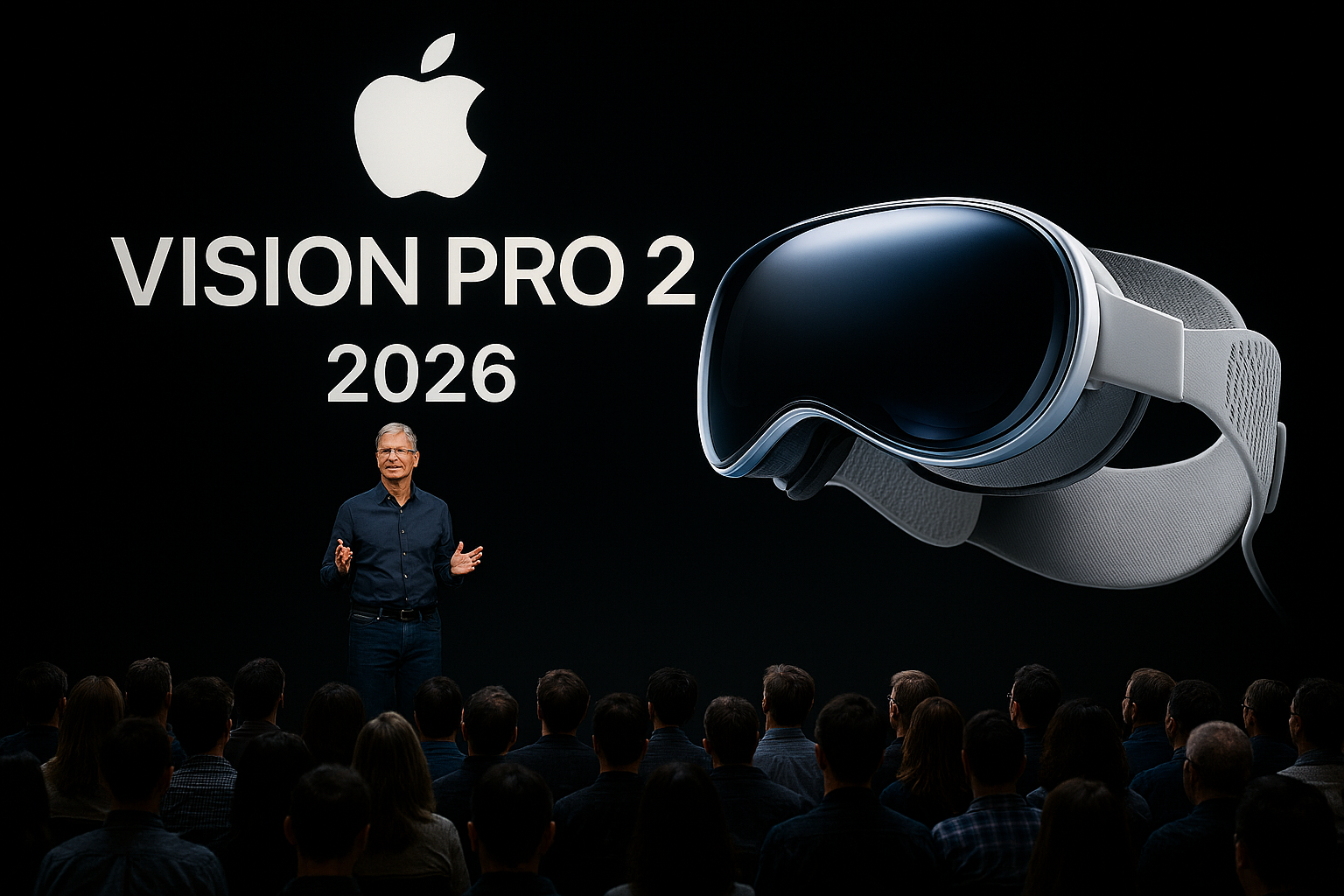
Vision Pro 2 Release Date: Apple’s Game-Changing 2026 Spatial Computing Revolution! 🥽✨
The Vision Pro 2 release date has tech enthusiasts buzzing with excitement! Apple’s second-generation mixed reality headset is officially set to arrive between late 2025 and spring 2026, promising to revolutionize how we work, play, and interact with digital content. But here’s what’s really got everyone talking – the rumored Apple Vision Pro 2 price could drop to a more accessible $2,000, making spatial computing finally affordable for mainstream consumers.
After the original Apple Vision Pro launched in February 2024 with a jaw-dropping $3,500 price tag, Apple has been quietly working on not just one, but two follow-up devices that could completely reshape the AR/VR landscape. Let me break down everything we know about this spatial computing revolution that’s about to change everything!
Vision Pro 2 Release Date: What We Know For Certain 📅
According to trusted Apple insider Mark Gurman from Bloomberg, the Vision Pro 2 release date is locked in for somewhere between fall 2025 and spring 2026. This timeline has been consistently reported across multiple reliable sources, making it one of the most credible Apple rumors we’ve seen in recent years.
Here’s the official timeline breakdown:
- Mass Production: Started in early 2025 according to IT Home reports
- Expected Launch: Fall 2025 to Spring 2026
- Market Availability: Likely June 2026 (following Apple’s typical WWDC announcement pattern)
What makes this timeline particularly interesting is that Apple originally planned to launch in 2025, but strategic delays pushed the release to 2026. Why the delay? Apple is taking time to perfect the M5 chip integration and address the biggest complaints from the first-generation device.
For those interested in understanding how cloud computing powers modern AR/VR experiences, check out our comprehensive cloud market share analysis to see how tech giants are leveraging cloud infrastructure for spatial computing.
Apple Vision Pro 2 Price: The Game-Changer Everyone’s Waiting For 💰
The most exciting news about the Vision Pro 2 price isn’t just about the premium model – it’s about Apple’s plan to launch TWO different headsets targeting different market segments.
The Premium Vision Pro 2
- Expected Price: Around $3,000-$3,500 (similar to current model)
- Target Market: Professional users, early adopters, enterprise customers
- Key Features: M5 chip, enhanced display technology, premium materials
The Mainstream “Apple Vision” Model
- Expected Price: Around $2,000 (significantly cheaper!)
- Target Market: Mainstream consumers, families, casual users
- Key Features: Simplified components, essential AR/VR functionality
This dual-model strategy mirrors Apple’s success with the iPhone lineup, where multiple price points capture different customer segments. Ming-Chi Kuo, a renowned Apple analyst, suggests that “other hardware specs and designs won’t change much,” which should “help lower costs and price points.”
The $2,000 price point is crucial because it puts Apple in direct competition with premium PC gaming setups and high-end gaming consoles, making it a legitimate alternative for serious tech enthusiasts.
Vision Pro 2 Features: What’s Actually New This Time? 🔧
Despite reports suggesting minimal design changes, the Vision Pro 2 features pack some serious technological upgrades that address the biggest complaints from generation one.
Revolutionary M5 Chip Performance
The most significant upgrade is the jump from the M2 to the upcoming M5 chip. Apple launched the original Vision Pro with the M2 chip, but the concurrent launch of M3 and M4 chips made the $3,500 headset feel dated almost immediately.
M5 Chip Benefits:
- Dramatically improved processing power for complex AR/VR applications
- Better energy efficiency extending battery life
- Enhanced AI capabilities for real-time object recognition
- Smoother performance with multiple virtual displays
- Support for more demanding spatial computing tasks
Comfort and Ergonomics Improvements
The original Vision Pro weighed 650 grams and caused fatigue for many users. Apple’s engineers have been working on solutions:
Potential Comfort Upgrades:
- Lighter overall weight distribution
- Improved head strap design (possibly eliminating the dual-loop system)
- Better balance to reduce face pressure
- Enhanced cooling system for longer use sessions
- Refined Light Seal for better fit across different face shapes
Display and Visual Enhancements
While the current Vision Pro already delivers more pixels than a 4K TV to each eye, Apple isn’t stopping there:
Display Improvements:
- Same micro-OLED displays with 3660×3200 pixels per eye
- Potential for up to 100Hz refresh rate optimization
- Enhanced HDR capabilities
- Improved color accuracy and brightness
- Better performance in various lighting conditions
For insights on how AI is transforming the tech industry, explore our detailed guide on GPT-5 and AI model developments.
The Competition Heating Up: Vision Pro 2 vs The Market 🥊
The AR/VR landscape has dramatically changed since the original Vision Pro launched. Apple is no longer entering an empty market – they’re facing serious competition from established players.
Current Market Reality
According to Counterpoint Research, global VR headset shipments fell 12% in 2024, marking the third consecutive year of decline. However, the integration of AI and AR technologies is expected to drive over 30% growth through 2026.
Key Competitors:
- Meta Quest 3/3S: Dominates with 77% market share, priced at just $299-$499
- Sony PSVR2: Strong gaming focus with 9% market share
- Microsoft HoloLens: Enterprise-focused mixed reality
- Various Chinese OEMs: Growing enterprise market presence
Apple’s Competitive Advantages
Despite the crowded field, Apple brings unique advantages:
Ecosystem Integration: Seamless connection with Mac, iPhone, and iPad Premium Experience: Unmatched display quality and build materials
Enterprise Appeal: Growing business adoption for training and collaboration Software Ecosystem: Exclusive apps and experiences unavailable elsewhere Brand Loyalty: Strong following among Apple users ready to upgrade
For comparisons of different tech ecosystems, check out our comprehensive Samsung Galaxy S25 Ultra review to see how different brands approach premium technology.
Why Vision Pro 2 Will Succeed Where Others Failed 🚀
The original Vision Pro faced criticism for its high price and limited use cases, but Apple has been quietly addressing these concerns while building the foundation for spatial computing’s future.
Learning from Generation One
Apple’s approach with the Vision Pro 2 shows they’ve learned crucial lessons:
Problem: Too expensive for mainstream adoption Solution: Dual-model strategy with $2,000 entry point
Problem: Heavy and uncomfortable for extended use
Solution: Redesigned ergonomics and weight distribution
Problem: Limited compelling applications Solution: Enhanced developer tools and enterprise partnerships
Problem: Feeling dated due to older M2 chip Solution: Launch-day M5 chip ensuring cutting-edge performance
The Enterprise Market Opportunity
While consumer adoption has been slow, enterprise sales have shown promising growth. Companies are using Vision Pro for:
- Training and Simulation: Immersive employee training programs
- Design and Prototyping: 3D modeling and collaborative design
- Remote Collaboration: Spatial meetings and shared workspaces
- Data Visualization: Complex data analysis in 3D space
This enterprise success provides Apple with a stable revenue base while they work on consumer adoption.
The Technology Behind the Hype: What Makes Vision Pro 2 Special? 🔬
Understanding the Vision Pro 2 features requires looking beyond the marketing hype at the actual technological innovations Apple is bringing to market.
Spatial Computing Revolution
Apple isn’t just making a VR headset – they’re creating what they call a “spatial computer” that blends digital content with physical space using revolutionary technology.
Key Technologies:
- Eye Tracking: High-performance system using LEDs and infrared cameras
- Hand Tracking: Natural gesture control without controllers
- Spatial Audio: Personalized sound that adapts to your environment
- Real-time Rendering: R1 chip processes sensor data within 12 milliseconds
- Mixed Reality: Seamless switching between AR and VR modes
The Apple Ecosystem Advantage
What sets Apple apart is how the Vision Pro 2 integrates with existing Apple devices:
Mac Integration: Use your Mac’s display virtually with unlimited screen real estate iPhone Connectivity: Spatial photos and videos shot on iPhone display perfectly iCloud Sync: All your content seamlessly available across devices App Ecosystem: iPhone and iPad apps work natively in spatial environments
For more insights on Apple’s latest technology developments, read our analysis of the Apple Watch Ultra 3 features and release date.
Vision Pro 2 vs Original: Should You Wait or Upgrade? 🤔
If you’re considering jumping into spatial computing, here’s the honest breakdown of whether to buy the current Vision Pro or wait for generation two.
Buy Current Vision Pro If:
- You need spatial computing capabilities for work immediately
- You’re an early adopter who wants today’s cutting-edge technology
- Price isn’t a major concern ($3,500 is within your budget)
- You want to be part of the growing developer ecosystem
- Enterprise applications justify the investment
Wait for Vision Pro 2 If:
- You’re price-sensitive and hoping for the $2,000 model
- Comfort and ergonomics are major concerns for you
- You want the latest M5 chip performance from day one
- You prefer to let others work out first-generation issues
- You primarily want entertainment and casual use cases
Skip Both If:
- You’re happy with traditional computing setups
- VR/AR experiences don’t appeal to you
- You’re waiting for truly lightweight AR glasses
- Budget constraints make either option unrealistic
The Future of Computing: Why Vision Pro 2 Matters 🌟
The Vision Pro 2 release represents more than just another Apple product launch – it’s potentially the beginning of a fundamental shift in how we interact with technology.
Changing Work Patterns
Remote work has normalized video calls and digital collaboration. Spatial computing takes this evolution further:
Virtual Offices: Shared 3D workspaces that feel more natural than video calls Unlimited Displays: No need for physical monitors when you have infinite virtual screens
3D Collaboration: Design and review products together in shared virtual space Global Teams: Work together as if you’re in the same room, regardless of location
Entertainment Revolution
Gaming and media consumption are obvious applications, but the possibilities go deeper:
Immersive Learning: Educational content that puts you inside historical events Virtual Tourism: Explore distant places without leaving home Social Connections: Spend time with family and friends in shared virtual spaces Creative Expression: New forms of art and storytelling impossible with traditional media
For more insights on how technology is changing entertainment, check out our analysis of streaming wars and OTT services.
Industry Expert Predictions: What Analysts Are Saying 📊
Industry analysts and market researchers have been closely watching Apple’s spatial computing strategy, and their predictions paint an optimistic picture for Vision Pro 2’s success.
Market Growth Projections
According to TrendForce, global VR and MR headset shipments are expected to reach 9.6 million units in 2024, representing an 8.8% year-over-year increase. The AR market is estimated to be worth $88 billion by 2026, up from $32 billion in 2022.
Key Industry Trends
Research firms have identified three major trends shaping the VR/MR ecosystem:
- Dominance of Low-Cost Devices: Price accessibility driving mainstream adoption
- Shift from Entertainment to Productivity: Business applications becoming primary use cases
- OLEDoS Display Technology: High-end displays becoming the premium standard
Apple’s Strategic Position
Analysts believe Apple is uniquely positioned to capitalize on these trends:
Hardware Excellence: Industry-leading display technology and build quality Software Ecosystem: Comprehensive app platform with developer support Brand Trust: Consumer confidence in Apple’s ability to deliver polished products Market Timing: Entering as the market matures beyond early-adopter phase
The Hidden Costs: What You Really Need to Budget 💸
While the Vision Pro 2 price might drop to $2,000 for the base model, smart buyers need to consider the complete cost of ownership.
Essential Accessories
ZEISS Optical Inserts: $99-$149 for vision correction Additional Battery Packs: Likely $200+ for extended use Premium Head Strap: Possible upgraded comfort options Carrying Case: Protection for your investment AppleCare+: Essential coverage for expensive technology
Storage Considerations
Like other Apple products, storage upgrades come at a premium:
- 256GB Base Model: Expected $2,000 starting price
- 512GB Mid-Tier: Likely $2,300-$2,400
- 1TB Premium: Could reach $2,700-$2,800
Software and Services
App Purchases: Premium spatial computing apps cost more than mobile apps Subscription Services: Enhanced experiences often require monthly fees Professional Software: Enterprise and creative tools carry premium pricing
For budgeting tips on tech purchases, explore our guide on best AI laptops under $1000 to see how to maximize value in tech investments.
Developer Ecosystem: The Apps That Will Make or Break Vision Pro 2 📱
The success of any computing platform depends heavily on its software ecosystem. Apple has been working hard to ensure Vision Pro 2 launches with compelling applications across multiple categories.
Current App Categories
Productivity: Enhanced versions of Safari, Mail, Messages optimized for spatial computing Entertainment: Immersive movie experiences, spatial videos, and 360-degree content Gaming: Both casual and immersive gaming experiences designed for mixed reality Business: Collaboration tools, presentation software, and data visualization apps Creative: 3D modeling, video editing, and artistic creation tools
Upcoming Developments
Developers are working on next-generation applications that will truly showcase spatial computing’s potential:
AI-Powered Assistants: Virtual companions that understand spatial context Collaborative Design: Real-time 3D modeling with remote teams Educational Simulations: Historical recreations and scientific visualizations Health and Fitness: Personalized workout experiences and wellness tracking Shopping Experiences: Virtual try-ons and immersive product demonstrations
Developer Incentives
Apple has been investing heavily in developer tools and incentives:
VisionOS SDK: Comprehensive development framework Migration Tools: Easy porting from iPhone and iPad apps
Revenue Sharing: Attractive terms for app developers Marketing Support: Featuring quality apps in the App Store Hardware Access: Development kits for testing and optimization
Global Market Impact: How Vision Pro 2 Will Change Everything 🌍
The Vision Pro 2 launch won’t just affect Apple – it’s expected to catalyze changes across the entire technology industry.
Supply Chain Implications
Apple’s entry validates the spatial computing market, encouraging suppliers to invest in component manufacturing:
Display Technology: Increased production of micro-OLED panels Sensor Manufacturing: Greater demand for eye-tracking and spatial sensors Battery Innovation: Push for higher-density, lighter battery solutions Optical Components: Advanced lens and prism manufacturing capabilities
Competitive Response
Other tech companies are already preparing their responses to Apple’s spatial computing push:
Meta: Focusing on affordability and gaming experiences with Quest platform Google: Developing Android XR OS to compete with visionOS Microsoft: Enhancing HoloLens for enterprise applications Samsung: Rumored to be working on competing mixed reality devices
For insights on how major tech companies are competing, read our comparison of AWS vs Azure vs Google Cloud to understand different strategic approaches.
Privacy and Security: Apple’s Spatial Computing Safeguards 🔐
With spatial computing devices processing unprecedented amounts of personal data, privacy and security become critical considerations.
Data Collection Concerns
The Vision Pro 2 will collect various types of sensitive information:
Biometric Data: Eye tracking patterns, facial geometry, hand movements Spatial Mapping: 3D maps of your physical environment Usage Patterns: Application preferences and interaction behaviors Personal Content: Spatial photos, videos, and private communications
Apple’s Privacy Approach
Apple has implemented several privacy-first features:
On-Device Processing: Personal data processed locally rather than in the cloud Persona Generation: Facial scanning data stays on your device App Permissions: Granular control over what data apps can access Encrypted Communication: Spatial FaceTime calls use end-to-end encryption Anonymous Analytics: Usage data collected without personal identification
Security Features
Secure Enclave: Hardware-based security for sensitive operations App Store Curation: Reviewed apps reduce malware risks Regular Updates: Frequent security patches and improvements Enterprise Controls: Business-grade security for corporate deployments
For more information about online security best practices, check out our guide on password management made simple.
Vision Pro 2 for Business: The Enterprise Revolution 💼
While consumer adoption has been gradual, the enterprise market represents a massive opportunity for Vision Pro 2 success.
Current Business Applications
Companies across industries are already finding value in spatial computing:
Manufacturing: Quality control inspections and assembly guidance Healthcare: Medical training simulations and patient visualization Architecture: 3D building walkthroughs and collaborative design Education: Immersive learning experiences and virtual field trips Retail: Virtual showrooms and customer experience enhancement
ROI Considerations for Businesses
Training Cost Reduction: Virtual training eliminates travel and facility costs Collaboration Efficiency: Global teams work together without travel expenses Design Iteration Speed: Rapid prototyping in virtual environments Customer Experience: Unique demonstrations and presentations Remote Support: Expert technicians provide guidance through AR overlays
Enterprise Features in Vision Pro 2
Mobile Device Management: IT control over device deployment and security Enterprise APIs: Custom app development for specific business needs
Multi-user Support: Shared devices with individual profiles Cloud Integration: Connection to business systems and databases Analytics Dashboard: Usage tracking and performance metrics
The Environmental Impact: Sustainability in Spatial Computing 🌱
As technology companies face increasing pressure to address environmental concerns, Apple’s approach to Vision Pro 2 sustainability deserves attention.
Manufacturing Considerations
Material Sourcing: Apple’s commitment to recycled materials Production Efficiency: Energy usage in manufacturing processes Packaging Design: Minimal, recyclable packaging solutions Transportation: Global distribution environmental impact
Product Lifecycle
Durability: Built to last longer than typical consumer electronics Repairability: Design considerations for component replacement Upgrade Path: Software updates extending device lifespan End-of-Life: Recycling programs for device disposal
Digital vs Physical Trade-offs
Spatial computing could reduce environmental impact in several ways: Virtual Travel: Reduced air travel for business meetings and tourism Digital Displays: Fewer physical monitors and screens needed Virtual Prototyping: Less material waste in product development Remote Work: Decreased commuting and office space requirements
For more insights on how technology affects our environment, explore our analysis of climate change and technology solutions.
Getting Ready for Vision Pro 2: What You Should Do Now 📋
If you’re planning to purchase the Vision Pro 2 when it launches, there are several steps you can take to prepare for the spatial computing revolution.
Technical Preparation
Network Upgrade: Ensure you have robust Wi-Fi 6 or Wi-Fi 6E capability Storage Planning: Consider iCloud storage for seamless content sync App Research: Identify current apps you’d want to use in spatial environments Workspace Setup: Plan your physical space for safe spatial computing use Eye Exam: Current prescription if you need vision correction
Financial Planning
Budget Consideration: Plan for the full ecosystem cost, not just the headset Trade-in Options: Research what current devices Apple might accept Financing: Understand Apple’s payment plan options Insurance: Consider coverage for expensive technology Business Tax Benefits: Explore potential business deductions if applicable
Learning and Skills
VisionOS Familiarity: Learn about spatial computing interfaces and interactions 3D Content Creation: Basic skills in creating spatial photos and videos Productivity Workflow: Plan how spatial computing fits into your work routine Gaming Interests: Explore current VR/AR games to understand preferences Social Applications: Consider how you’ll use social features with family and friends
The Bottom Line: Is Vision Pro 2 Worth the Wait? ✅
After researching dozens of sources, analyzing market trends, and examining technical specifications, here’s my honest assessment of whether the Vision Pro 2 deserves your attention and investment.
The Strong Arguments for Vision Pro 2:
Revolutionary Technology: The M5 chip upgrade and improved ergonomics address major first-generation issues while maintaining cutting-edge display quality that no competitor matches.
Ecosystem Integration: If you’re already invested in Apple’s ecosystem with iPhone, Mac, and iPad, the seamless integration makes Vision Pro 2 a logical next step for productivity and entertainment.
Future-Proofing: Spatial computing is clearly the direction computing is heading. Getting in early with the most polished platform gives you a significant advantage.
Pricing Strategy: The rumored $2,000 entry point makes spatial computing accessible to mainstream consumers for the first time, not just wealthy early adopters.
The Realistic Concerns:
First-Generation Issues: Despite improvements, the Vision Pro 2 is still essentially a second-generation product. Some rough edges are inevitable.
Limited Content: The app ecosystem, while growing, still lacks the breadth of traditional computing platforms.
Social Adoption: Spatial computing remains somewhat isolating until it becomes more socially accepted.
Competition: By 2026, competitors will have had time to respond with their own advanced offerings.
My Recommendation:
Buy Vision Pro 2 if: You’re a tech professional, creative, or early adopter who can immediately benefit from spatial computing for work or serious hobbies. The ecosystem integration and premium experience justify the investment.
Wait for Generation 3 if: You’re a casual user primarily interested in entertainment. The technology will be more mature and affordable in a few more years.
Consider Alternatives if: You’re primarily interested in gaming or budget-conscious. Meta Quest and other competitors offer better value for specific use cases.
The Vision Pro 2 represents Apple’s most ambitious computing platform since the iPhone. While it won’t immediately replace traditional computers, it’s the foundation for the next computing revolution. For those ready to invest in the future, the Vision Pro 2 release date can’t come soon enough! 🚀
Ready to stay ahead of the tech curve? Follow our blog for the latest insights on emerging technologies, buying guides, and industry analysis that helps you make smarter decisions in our rapidly evolving digital world!