
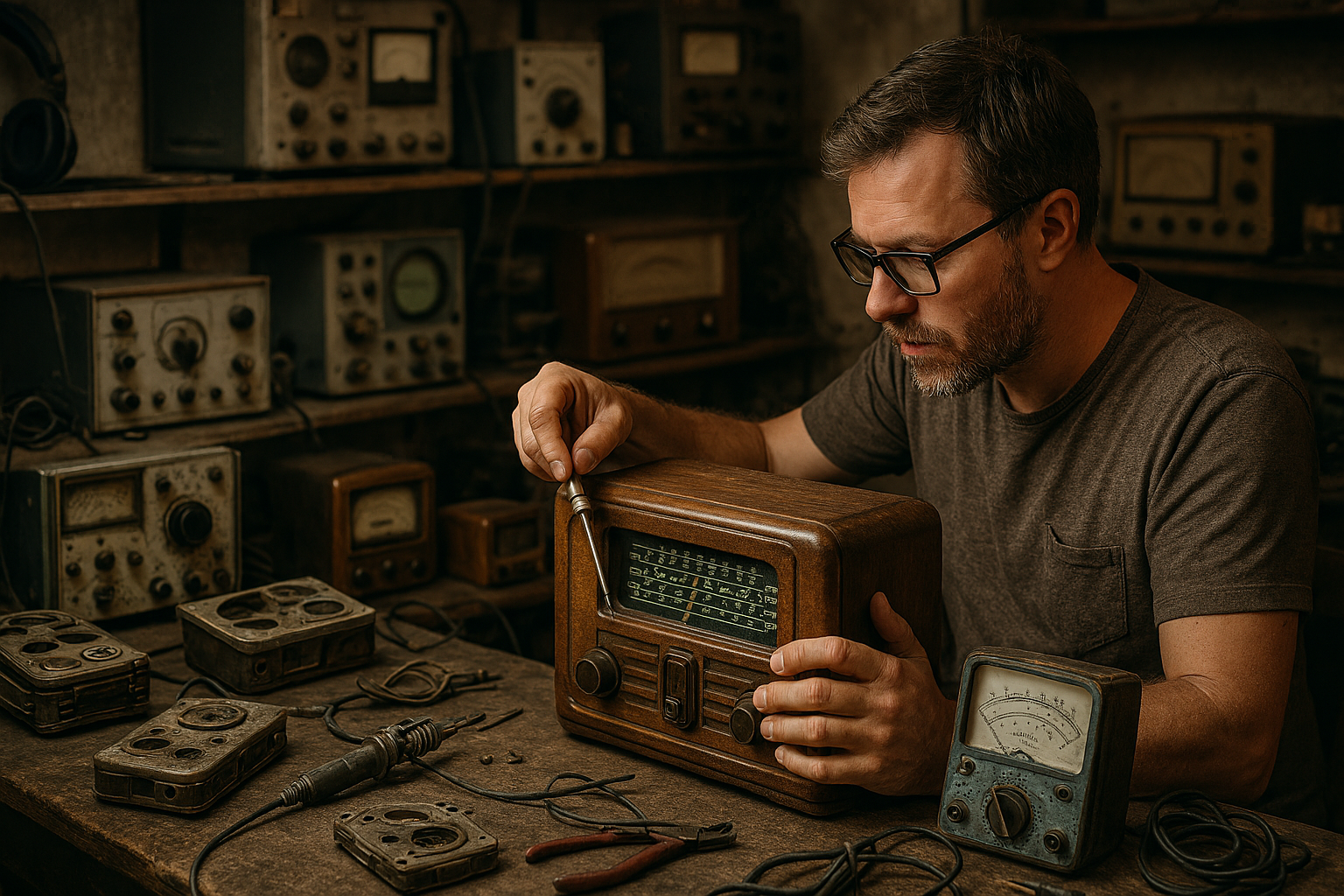
Turn Junk into $1000+ Profits 🔧⚡
Ever walked past that dusty old radio at a garage sale and wondered if it could be worth something? Well, buckle up because vintage electronics restoration is about to blow your mind! 🤯 What looks like electronic junk to most people could be your golden ticket to earning $1000+ in profits.
The vintage electronics restoration business is absolutely exploding in 2025! With the second-hand market growing 21 times faster than traditional retail and the refurbished electronics market expected to reach $123.71 billion by 2033, there’s never been a better time to turn your love for old gadgets into serious cash. 💰
Why Vintage Electronics Restoration is the Ultimate Side Hustle 🚀
Picture this: you buy a broken 1960s tube radio for $25 at a flea market, spend a weekend restoring it, and sell it for $400. That’s not a fantasy – it’s happening every single day across America! The vintage electronics restoration market combines nostalgia, craftsmanship, and serious profit potential.
Here’s what makes this business so incredible:
- Low startup costs: You can begin with basic tools for under $500
- High profit margins: 40-80% profit margins are common
- Growing demand: Vintage electronics are “suddenly all the rage again” according to consumer trends analyst Thomas Paddock
- Flexible schedule: Work from home, set your own hours
- Multiple revenue streams: Repair services, restored sales, parts dealing, and teaching
The best part? You don’t need an engineering degree to get started! Most vintage electronics restoration involves replacing standard components like capacitors, cleaning circuits, and basic soldering – skills anyone can learn in a few weekends.
The Most Profitable Vintage Electronics to Restore 📻
Tube Radios: The Goldmine of Restoration 🎵
Vintage tube radios from the 1930s-1960s are absolute profit machines! These beauties combine nostalgia with that warm, analog sound that modern devices just can’t replicate. Most tube radios need simple capacitor replacements to bring them back to life, and they command premium prices once restored.
Profit potential:
- Purchase price: $15-$75 at garage sales
- Restoration cost: $20-$50 in parts
- Selling price: $200-$800 (premium models can hit $1,500+)
- Net profit: $150-$650 per radio!
Vintage Amplifiers: Musicians Pay Big Money 🎸
Guitar amplifiers from the 1950s-1980s are pure gold for restoration enthusiasts. Vintage tube amplifiers are often in serious need of restoration but can sound as good or better than modern amps once properly restored. Musicians and audiophiles will pay serious money for a properly restored vintage amp.
Hot sellers include:
- Fender tube amps (1950s-1970s): $500-$3,000+
- Marshall stacks (1960s-1980s): $800-$2,500+
- Vox AC30s: $600-$1,800+
- Gibson amplifiers: $400-$1,500+
Record Players and Turntables: Riding the Vinyl Wave 🎶
With vinyl sales absolutely booming, vintage turntables are in massive demand! Many seized or non-functional turntables can be returned to working order with professional lubrication and basic adjustments. The vinyl revival has created a hungry market for quality vintage players.
Restoration goldmines:
- Technics SL-1200s: $300-$1,200 restored
- Pioneer PL-series: $150-$600 restored
- Dual turntables: $200-$800 restored
- Sony direct-drive models: $180-$500 restored
Vintage Computers: Tech History Pays Well 💻
Old Apple computers, early PCs, and gaming systems are experiencing a massive collector boom. A working vintage Mac with software and accessories rarely sells for less than $150, with tested systems in great condition averaging $250.
Computer restoration profits:
- Apple Macintosh Classic: $100-$300 restored
- Commodore 64: $100-$700 depending on condition
- Early Apple computers: $500-$2,500+
- IBM PC compatibles: $75-$400
Just like understanding the complete history of computing helps tech professionals appreciate modern systems, knowing vintage computer history adds massive value to your restoration work!
Essential Tools for Vintage Electronics Restoration 🛠️
Basic Tool Kit (Under $300 Startup)
The tools necessary for electronic restoration are neither extensive nor especially expensive, but don’t scrimp on quality. Here’s what you absolutely need:
Soldering Equipment:
- Quality soldering iron (40-60 watts): $25-$60
- Solder (60/40 rosin core): $10-$15
- Desoldering wick: $5-$10
- Flux: $8-$12
Testing Equipment:
- Digital multimeter: $30-$80
- Component tester: $25-$50
- Oscilloscope (basic): $100-$200
Hand Tools:
- Precision screwdriver set: $15-$30
- Needle-nose pliers: $10-$20
- Wire strippers: $8-$15
- Dental picks for cleaning: $10-$15
Advanced Setup (Professional Level)
As your business grows, invest in professional-grade equipment:
- Ultrasonic cleaner: $150-$400
- Hot air rework station: $200-$500
- Variable power supply: $100-$300
- Function generator: $200-$600
Pro tip: Just like setting up the perfect home office requires the right tech tools, having quality restoration equipment makes all the difference in your results and efficiency!
Step-by-Step Restoration Process: From Junk to Treasure ✨
Phase 1: Assessment and Planning 🔍
Before touching anything, thoroughly evaluate your find:
Safety first! Never power on a vintage radio without inspecting it first and replacing capacitors at minimum. Many vintage electronics use dangerous voltages that can seriously hurt you.
Visual inspection checklist:
- Check for obvious damage (cracks, missing parts, burn marks)
- Examine the power cord (replace if frayed or damaged)
- Look for corrosion on metal components
- Test all knobs and switches for smooth operation
- Take photos before disassembly for reference
Phase 2: The Restoration Magic 🎩
Start with the big three:
- Replace all electrolytic capacitors – These fail first and cause most problems
- Replace paper/wax capacitors – They degrade over 20+ years
- Check and replace out-of-tolerance resistors – Carbon composition resistors drift over time
Replacing all paper capacitors, electrolytic capacitors, and carbon composition resistors will bring most vintage electronics to an operating state and is the most efficient restoration method.
The cleaning process:
- Disassemble carefully (take photos at each step!)
- Use ultrasonic cleaner for chassis and metal parts
- Clean tube sockets with DeoxIT contact cleaner
- Polish metal surfaces to original luster
- Replace worn rubber parts (belts, grommets, feet)
Phase 3: Testing and Alignment 🎯
Power up safely:
- Use a variac (variable transformer) for first power-up
- Gradually increase voltage while monitoring current
- Check all voltages against service manual specifications
- Align radio frequencies if necessary (requires specialized equipment)
- Burn-in test for 24-48 hours before sale
Building Your Vintage Electronics Restoration Business 💼
Starting Small: Weekend Warrior Approach
You don’t need to quit your day job immediately! Many successful restorers start as weekend warriors:
Month 1-3: Learning Phase
- Buy 2-3 simple tube radios to practice on
- Master basic soldering and component replacement
- Study service manuals and schematics
- Join vintage electronics forums and Facebook groups
Month 4-6: Building Skills
- Tackle more complex projects (amplifiers, turntables)
- Start selling restored pieces on eBay and Facebook Marketplace
- Build relationships with local antique dealers
- Create social media presence showcasing your work
Month 7-12: Scaling Up
- Establish regular sourcing channels (estate sales, auctions)
- Develop signature restoration techniques
- Build customer base through word-of-mouth
- Consider specializing in specific brands or types
Sourcing Your Raw Materials: Where to Find Golden Opportunities 🏆
Best places to find restoration candidates:
- Estate sales: Often the best source for rare, valuable pieces
- Garage sales: Great for volume purchases and negotiating
- Flea markets: Regular vendors often save special pieces for serious buyers
- Antique malls: Higher prices but better quality and selection
- Online auctions: eBay, Facebook Marketplace, local auction houses
- Ham radio swap meets: Treasure troves of vintage radio equipment
Sourcing secrets from the pros:
- Arrive early to estate sales for best selection
- Build relationships with estate sale companies
- Learn to spot diamond-in-the-rough pieces others miss
- Focus on well-known brands: Zenith, Philco, RCA, Motorola, Stromberg-Carlson
Pricing Your Restored Electronics: Maximizing Profits 💵
Industry benchmarks suggest average profit margins for vintage electronic repair shops typically range between 15% to 25%, but specialized restoration can achieve much higher margins.
Pricing strategy framework:
- Research completed sales on eBay for comparable items
- Factor in your time at $25-$75 per hour (based on skill level)
- Add material costs plus 20-30% markup
- Consider rarity and condition premiums
- Price competitively but don’t undervalue your work
Sample pricing structure:
- Basic cleaning and testing: $50-$100
- Component replacement (caps/resistors): $150-$300
- Full restoration with cosmetic work: $300-$800
- Rare or high-end pieces: $500-$2,000+
Marketing Your Restoration Business: Building Your Empire 📈
Digital Marketing That Actually Works
Social media goldmine: Your restoration journey is content gold! People love transformation videos and before/after photos. Share your process on:
- Instagram: Before/after photos with restoration stories
- TikTok: Time-lapse restoration videos (these go viral!)
- YouTube: Detailed tutorials and project walkthroughs
- Facebook: Join vintage electronics groups and share your work
Just like successful AI tools help everyday users be more productive, social media tools can dramatically expand your restoration business reach!
eBay and Etsy optimization:
- Use detailed titles with brand names and model numbers
- Include multiple high-quality photos from every angle
- Write compelling descriptions emphasizing restoration quality
- Offer international shipping to reach global collectors
- Maintain 100% positive feedback through excellent service
Building Customer Relationships 🤝
Service excellence strategies:
- Provide detailed restoration documentation with photos
- Offer 90-day warranties on your work
- Create customer education content about proper care
- Follow up after sales to ensure satisfaction
- Ask satisfied customers for reviews and referrals
Partnership opportunities:
- Local antique dealers who need restoration services
- Music stores selling vintage instruments and amps
- Audio enthusiasts and hi-fi shops
- Interior designers using vintage electronics as decor
- Wedding planners seeking unique vintage props
Advanced Restoration Techniques: Separating Pros from Amateurs 🎓
Cosmetic Restoration Mastery
Dealing with yellowed plastic: Many vintage electronics suffer from plastic yellowing due to UV exposure and bromine in flame retardants. Plastics yellow due to bromine reaction in flame retardant, but the plastic beneath is still perfectly fine.
Retrobrite process:
- Mix hydrogen peroxide cream with small amount of TAED activator
- Apply to yellowed plastic parts
- Wrap in plastic and expose to UV light for 6-12 hours
- Results in dramatic whitening back to original color
Cabinet restoration:
- Strip old finish carefully with appropriate solvents
- Sand progressively from 220 to 400 grit
- Apply period-appropriate stains and finishes
- Replace worn fabric on speaker grilles
- Restore original logos and badges
Electronic Troubleshooting Like a Pro 🔬
Systematic approach to diagnosis:
- Visual inspection: Look for obvious damage, burn marks, corrosion
- Power supply check: Verify all voltages are within specification
- Signal tracing: Follow audio/video signals through the circuit
- Component testing: Check resistors, capacitors, tubes individually
- Alignment: Ensure RF circuits are properly tuned
Common failure patterns by decade:
- 1930s-1940s: Paper capacitors, carbon resistors, tube sockets
- 1950s-1960s: Electrolytic capacitors, selenium rectifiers, rubber parts
- 1970s-1980s: Integrated circuits, plastic gears, belt drives
- 1990s-2000s: Surface-mount components, LCD displays, optical lasers
Specialized Niches: Where the Big Money Lives 💎
High-End Audio Equipment: Audiophile Heaven 🎵
The high-end audio restoration market is incredibly lucrative. Vintage Neumann U47 microphones sell for around $20,000, while Western Electric WE 753C loudspeakers are regarded as having possibly the most distinct sound of any speaker in history.
Premium brands to watch for:
- McIntosh: Amplifiers regularly sell for $2,000-$8,000+ restored
- Marantz: Classic tube receivers: $800-$3,000+
- Fisher: High-end separates: $500-$2,500+
- Scott: Tube amplifiers: $400-$1,800+
Vintage Computing: Tech History Goldmine 🖥️
The retrocomputing community pays premium prices for properly restored vintage computers. Retrocomputing is part of computer hardware history and can be seen as experimental archaeology in computing.
Hot computer categories:
- Early Apple computers: Original Macintosh, Apple II series
- IBM compatibles: Early PCs with original software
- Gaming computers: Amiga, Atari ST, early Windows machines
- Workstations: SGI, Sun Microsystems, DEC equipment
Restoration focus points:
- Replace failing electrolytic capacitors (critical!)
- Clean and lubricate floppy drives
- Retrobrite yellowed plastic cases
- Source period-appropriate software and manuals
- Test with original peripherals when possible
Gaming Consoles: Nostalgia Pays the Bills 🎮
Gaming consoles like the Atari 2600 can fetch $50 to $2,000 depending on condition and rarity, while NES consoles and cartridges are valuable relics of the gaming world.
Console restoration essentials:
- Cartridge slot cleaning: The #1 issue with most retro consoles
- Controller repair: Replace worn joysticks and buttons
- Optical drive alignment: Critical for CD-based systems
- Capacitor replacement: Prevents logic board damage
- Cosmetic restoration: Clean yellowing, replace missing parts
Business Structure and Legal Considerations ⚖️
Setting Up Your Legal Foundation
Choose your business structure:
- LLC (Recommended): Protects personal assets, tax flexibility
- Sole Proprietorship: Simplest start but no liability protection
- Corporation: Best for scaling but more complex
Essential business elements:
- Business license and reseller permit
- General liability insurance ($300-$800 annually)
- Dedicated workspace with proper ventilation
- Record-keeping system for purchases and sales
- Safety equipment (fire extinguisher, first aid kit)
Insurance and Safety Considerations 🛡️
Working with vintage electronics involves some unique risks:
- Electrical safety: Many vintage items use dangerous voltages
- Fire risk: Old components can overheat or short circuit
- Chemical exposure: Some restoration chemicals require ventilation
- Property insurance: Protect your inventory and workspace
Safety protocols:
- Always use isolation transformers when testing
- Discharge capacitors before working on equipment
- Work in well-ventilated area when using solvents
- Keep fire extinguisher rated for electrical fires nearby
- Never work on live circuits
Where to Sell Your Restored Electronics: Maximizing Revenue 🏪
Online Platforms: Your Digital Storefront
eBay: The King of Vintage Sales eBay and Etsy are popular choices for selling vintage electronics, allowing sellers to reach a broad audience of collectors and enthusiasts. eBay’s auction format is perfect for rare pieces where you’re not sure of market value.
Platform-specific strategies:
- eBay: Use auction format for rare pieces, Buy It Now for common items
- Etsy: Focus on artistically appealing restorations and unique pieces
- Facebook Marketplace: Great for local sales, no shipping hassles
- Reverb: Specifically for musical equipment and audio gear
- Specialized forums: Vintage audio forums, retro computing communities
Local Market Opportunities 🏠
Physical selling venues:
- Antique malls and vintage shops (consignment or wholesale)
- Audio/electronics trade shows and swap meets
- Local hi-fi and music shops
- Estate sale companies (they often need restoration services)
- Word-of-mouth referrals from satisfied customers
Service-based income:
- Repair services for collectors who can’t DIY
- Consultation for identifying valuable pieces
- Custom modification services (adding Bluetooth, etc.)
- Teaching restoration workshops and classes
Advanced Profit Strategies: Taking It to the Next Level 📊
Diversifying Your Revenue Streams 🌊
Multiple income sources:
- Restoration services: $50-$200 per hour depending on complexity
- Buying and flipping: 100-400% profit margins possible
- Parts supply: Sell restored components to other restorers
- Educational content: YouTube ad revenue, paid courses, eBooks
- Consulting: Help others identify valuable finds
Seasonal opportunities:
- Spring/Summer: Estate sale season peaks
- Fall: Vintage audio equipment popular before holidays
- Winter: Indoor hobby season drives restoration demand
- Year-round: Online sales continue regardless of season
Scaling Your Operation 📈
Growing from hobby to business:
- Phase 1: Weekend restoration hobby ($500-$2,000/month)
- Phase 2: Part-time business ($2,000-$6,000/month)
- Phase 3: Full-time restoration business ($6,000-$15,000+/month)
- Phase 4: Multi-employee operation with specializations
Scaling strategies:
- Hire apprentices to handle simpler restorations
- Develop signature restoration techniques
- Create branded restoration packaging
- Establish wholesale relationships with dealers
- Consider franchising successful restoration methods
Common Restoration Challenges and Solutions 🚧
Parts Sourcing: The Eternal Challenge
Finding original parts is often the biggest restoration challenge. Finding replacement parts can be difficult as many original components are no longer manufactured, but 3D printing offers solutions for custom parts.
Modern solutions:
- 3D printing: Create custom knobs, buttons, and cases
- Component substitution: Modern equivalents for vintage parts
- Parts harvesting: Buy broken units for components
- Reproduction services: Companies making replica parts
- International sourcing: European and Asian suppliers
Technical Challenges 🔧
Most common restoration issues:
- Capacitor failure: Causes hum, distortion, total failure
- Tube socket corrosion: Prevents proper tube contact
- Power transformer failure: Often economically irreparable
- Mechanical wear: Requires cleaning, lubrication, adjustment
- Circuit board damage: Requires traces repair or replacement
Solutions and workarounds:
- Keep detailed service manuals and schematics library
- Build relationships with other restorers for knowledge sharing
- Invest in quality test equipment for accurate diagnosis
- Learn multiple repair techniques for common problems
- Maintain inventory of common replacement parts
Marketing Secrets: Standing Out in the Vintage World 🌟
Content Marketing That Converts
Video content dominance: Time-lapse restoration videos perform incredibly well on social media. People love seeing broken junk transformed into beautiful, functional electronics.
Content ideas that drive sales:
- Before/after transformation videos
- “Will it work?” testing videos of garage sale finds
- Tutorial content teaching basic restoration techniques
- Historical deep-dives into specific brands or models
- Live streaming restoration sessions with Q&A
SEO content strategy: Create blog content around restoration topics, just like how tech blogs cover smartphone features most users miss. Share your expertise through detailed guides.
Building Your Personal Brand 🎨
Establishing expertise:
- Document your restoration process meticulously
- Share knowledge freely in vintage electronics communities
- Attend vintage electronics shows and swap meets
- Write guest articles for vintage hobby magazines
- Offer free consultations to build trust
Customer trust builders:
- Detailed process documentation: Show every step with photos
- Warranty offerings: 90-day guarantees on your restoration work
- Transparent pricing: Explain what goes into your pricing
- Educational approach: Teach customers about their restored items
- Quality materials: Use only high-grade replacement components
Technology Integration: Modern Tools for Vintage Work 🔗
Digital Tools for Restoration Business
Essential software:
- Parts sourcing: apps for finding components across multiple suppliers
- Documentation: High-quality cameras for process photography
- Testing: Smartphone apps that function as basic test equipment
- Business management: QuickBooks for financial tracking
- Customer service: CRM systems for client communication
Modern enhancements: Many restorers add modern convenience features while maintaining vintage aesthetics:
- Bluetooth connectivity in vintage radios
- USB charging ports in vintage electronics
- LED backlighting in vintage computers
- Modern safety features in vintage amplifiers
Just like smart home technology can upgrade modern houses, tasteful modern additions can enhance vintage electronics without destroying their character.
Understanding Your Market: Who Buys Restored Electronics? 🎯
Primary Customer Segments
Collectors and Enthusiasts (40% of market):
- Seek authentic, museum-quality restorations
- Pay premium prices for rare or significant pieces
- Value historical accuracy and proper documentation
- Often become repeat customers and referral sources
Musicians and Audio Professionals (25% of market):
- Need reliable vintage amplifiers and audio equipment
- Focus on sound quality over cosmetic perfection
- Will pay for performance modifications and upgrades
- Often need multiple pieces for studios or touring
Interior Designers and Decorators (20% of market):
- Want visually appealing pieces for staging and decor
- Prefer fully cosmetic restorations
- May not need full electrical functionality
- Often buy in bulk for multiple projects
Nostalgic Consumers (15% of market):
- Seeking items from their youth or family history
- Emotional purchasers willing to pay premium prices
- Value the story and history behind pieces
- Often gift restored items to family members
Market Trends Driving Demand 📊
Key factors boosting the restoration market:
- Sustainability movement: People prefer restoring over discarding
- Nostalgia cycle: 20-30 year cycles bring renewed interest
- Quality appreciation: Modern electronics often perceived as disposable
- Unique aesthetics: Vintage designs stand out in modern settings
- Investment potential: Well-restored pieces appreciate in value
The second-hand market is expanding at a rate 21 times faster than traditional retail stores, driven by Generation Y and Z’s environmental consciousness.
Financial Planning: Building Wealth Through Restoration 💰
Revenue Projections by Experience Level
Beginner (0-1 year):
- 2-4 projects per month
- Average profit per project: $100-$300
- Monthly income: $200-$1,200
- Annual potential: $2,400-$14,400
Intermediate (1-3 years):
- 6-10 projects per month
- Average profit per project: $200-$500
- Monthly income: $1,200-$5,000
- Annual potential: $14,400-$60,000
Expert (3+ years):
- 10-20 projects per month
- Average profit per project: $300-$800
- Monthly income: $3,000-$16,000
- Annual potential: $36,000-$192,000
Business scaling additions:
- Teaching workshops: $200-$500 per session
- Consultation services: $75-$150 per hour
- Parts sales: 20-50% markup on hard-to-find components
- Custom modifications: $100-$500 per project
Investment and ROI Analysis 📈
Startup investment tiers:
Hobbyist Level ($500-$1,500):
- Basic tools and test equipment
- Small inventory of common parts
- Home workspace setup
- ROI: 200-400% within first year
Semi-Professional ($2,000-$5,000):
- Professional-grade tools
- Ultrasonic cleaner and advanced test equipment
- Larger parts inventory
- Dedicated workspace improvements
- ROI: 300-600% within 18 months
Professional Operation ($5,000-$15,000):
- Complete professional workshop
- Specialized test equipment
- Large parts inventory and reference library
- Vehicle for sourcing expeditions
- ROI: 400-800% within 24 months
Working at $75 per hour with an 80% profit margin, you could make $480 for a full workday in antique restoration.
Technology and Restoration: Modern Meets Vintage ⚡
Integrating Modern Technology
Smart restoration techniques: Modern technology can dramatically improve your restoration results:
- Digital photography: Document every step for customer confidence
- 3D printing: Create missing knobs, brackets, and decorative elements
- Computer-aided design: Recreate original schematics and layouts
- Online databases: Access vast libraries of service manuals
- Component testing apps: Smartphone apps for basic measurements
Hybrid restoration approaches: Some customers love vintage aesthetics with modern functionality:
- Adding Bluetooth to vintage radios while maintaining original controls
- Installing modern safety features in vintage amplifiers
- Retrofitting LED displays in vintage equipment
- Adding USB charging to vintage clock radios
Understanding both vintage circuits and modern technology trends gives you a huge competitive advantage in restoration work.
Documentation and Quality Assurance 📋
Professional documentation process:
- Photograph device before, during, and after restoration
- Document all component replacements with part numbers
- Create performance test reports with measurements
- Provide care instructions and operational guidance
- Maintain customer database with restoration history
Quality assurance protocols:
- 48-hour burn-in testing for all restored electronics
- Performance verification against original specifications
- Cosmetic inspection under multiple lighting conditions
- Customer satisfaction follow-up after 30 days
- Warranty tracking and service record maintenance
Future Opportunities: Where the Market is Heading 🔮
Emerging Trends in Vintage Electronics
Hot categories for 2025:
- Early gaming systems: Nintendo, Atari, Sega gaining collector status
- Vintage computers: Apple, Commodore, early IBM systems
- Professional audio: Recording studio equipment from 1960s-1980s
- Test equipment: Vintage oscilloscopes, signal generators
- Communication devices: Ham radios, early cell phones
Technology convergence opportunities:
- Smart home integration with vintage electronics
- IoT connectivity for vintage audio systems
- App-controlled vintage equipment
- Vintage aesthetics with modern streaming capability
- Augmented reality overlays for vintage computer interfaces
Building Long-Term Wealth 🏦
Investment strategies:
- Buy and hold: Acquire rare pieces for long-term appreciation
- Restore and rent: Vintage electronics for film/TV productions
- Educational empire: Build online courses and certification programs
- Franchise opportunities: License your restoration methods
- Technology development: Create modern components for vintage equipment
Compound growth strategies: Start by restoring individual pieces, but think bigger:
- Partner with antique dealers for exclusive restoration contracts
- Develop relationships with auction houses for high-end pieces
- Create subscription-based restoration services for collectors
- Build online marketplace specifically for restored vintage electronics
The same principles that drive successful remote work careers apply to restoration businesses – continuous learning, building valuable skills, and leveraging technology for efficiency.
Getting Started This Weekend: Your Action Plan 🎯
Weekend 1: Foundation Building
Friday evening: Research and education
- Join Facebook groups: “Vintage Electronics Restoration,” “Antique Radio Collectors”
- Download free service manuals from radiomuseum.org
- Watch YouTube restoration channels for technique insights
- Study eBay completed listings for pricing research
Saturday: Tool acquisition
- Visit local electronics store for basic soldering supplies
- Check Harbor Freight for affordable hand tools
- Order digital multimeter online (arrive by next weekend)
- Set up basic workspace in garage or basement
Sunday: First acquisition
- Hit garage sales early (arrive at opening time)
- Look for tube radios, vintage stereo equipment, old electronics
- Budget $50-$100 for first few practice pieces
- Focus on common brands: Zenith, RCA, Philco for first projects
Weekend 2: First Restoration Project
Saturday: Disassembly and assessment
- Photograph everything before touching
- Carefully disassemble first project
- List all needed replacement parts
- Order capacitors and resistors online
Sunday: Learning and planning
- Study service manual for your specific model
- Watch relevant restoration videos
- Plan your restoration approach
- Prepare workspace for upcoming restoration work
Month 1 Goal: Complete First Profitable Restoration
By the end of your first month, you should have:
- Successfully restored your first vintage electronic
- Learned basic soldering and component replacement
- Listed and sold your first restoration for profit
- Planned your next 2-3 projects
- Established relationships with parts suppliers
Remember, just like mastering complex cloud technologies requires patience and practice, vintage electronics restoration is a skill that improves dramatically with experience.
Expert Tips from Professional Restorers 🎖️
Wisdom from the Trenches
Quality over quantity approach: Expert vintage amp restoration focuses on attention to detail and meticulous duplication of original circuitry rather than rushing through repairs. Take time to do things right the first time.
Building expertise systematically:
- Start with simpler projects (basic radios) before tackling complex equipment
- Specialize in specific brands or eras to build deep knowledge
- Keep detailed records of every restoration for future reference
- Never stop learning – vintage electronics technology varies dramatically
Customer service excellence:
- Always under-promise and over-deliver on timelines
- Provide detailed explanations of work performed
- Offer genuine warranties backed by quality workmanship
- Build relationships, not just transactions
Avoiding Common Beginner Mistakes
Technical mistakes:
- Don’t power up vintage equipment without checking capacitors first
- Never assume schematic voltages are safe – many vintage items use lethal voltages
- Always discharge capacitors before working on equipment
- Don’t mix modern and vintage component types without understanding implications
Business mistakes:
- Don’t undervalue your time and expertise
- Avoid taking on projects beyond your current skill level
- Don’t skimp on quality tools and test equipment
- Never promise delivery dates you can’t absolutely meet
The Environmental Impact: Restoration as Conservation 🌱
Sustainability Meets Profitability
Vintage electronics restoration isn’t just profitable – it’s environmentally responsible! Growing environmental consciousness is driving people to choose second-hand goods to reduce waste and increase product longevity.
Environmental benefits:
- Waste reduction: Keep electronics out of landfills
- Energy conservation: Avoid manufacturing energy for new products
- Resource preservation: Extend life of existing materials
- Chemical reduction: Prevent toxic materials from entering waste stream
Marketing the green angle: Today’s consumers increasingly value environmental responsibility. Position your restoration business as:
- “Giving electronics a second life”
- “Sustainable technology solutions”
- “Preserving history while protecting the environment”
- “Quality craftsmanship over disposable culture”
This environmental angle appeals especially to younger customers who might not otherwise be interested in vintage electronics but appreciate the sustainability message.
Conclusion: Your Vintage Electronics Empire Awaits 👑
The vintage electronics restoration business offers an incredible opportunity to combine creativity, technical skills, and entrepreneurship into a highly profitable venture. With profit margins of 40-80%, growing market demand, and multiple revenue streams, this isn’t just a hobby – it’s a legitimate path to financial independence.
Whether you’re looking to earn an extra $500 per month or build a six-figure restoration empire, the fundamentals remain the same: start small, focus on quality, build relationships, and never stop learning. Electronics stores can expect profit margins around 40%, and with vintage restoration commanding premium prices, your margins can be even higher.
The vintage electronics market isn’t going anywhere. As technology continues advancing at breakneck speed, the appeal of well-crafted, repairable electronics from a bygone era only grows stronger. Every iPhone that breaks and gets replaced, every disposable gadget that fails after two years, makes vintage electronics look more appealing by comparison.
Your next steps:
- Start this weekend with your first garage sale purchase
- Join online communities and start learning
- Complete your first restoration project within 30 days
- List and sell your first restored piece for profit
- Reinvest profits into better tools and more inventory
Remember, every expert was once a beginner. That dusty old radio in your grandmother’s attic could be the start of your vintage electronics restoration empire. The only question is: are you ready to turn someone else’s electronic junk into your treasure?
Just like learning to use AI tools can transform your professional productivity, mastering vintage electronics restoration can transform your financial future. The tools, knowledge, and market opportunity are all there – now it’s time to take action!
Start small, dream big, and get ready to discover the incredible world of vintage electronics restoration where yesterday’s discarded technology becomes tomorrow’s profitable treasure! 🎉⚡💰