
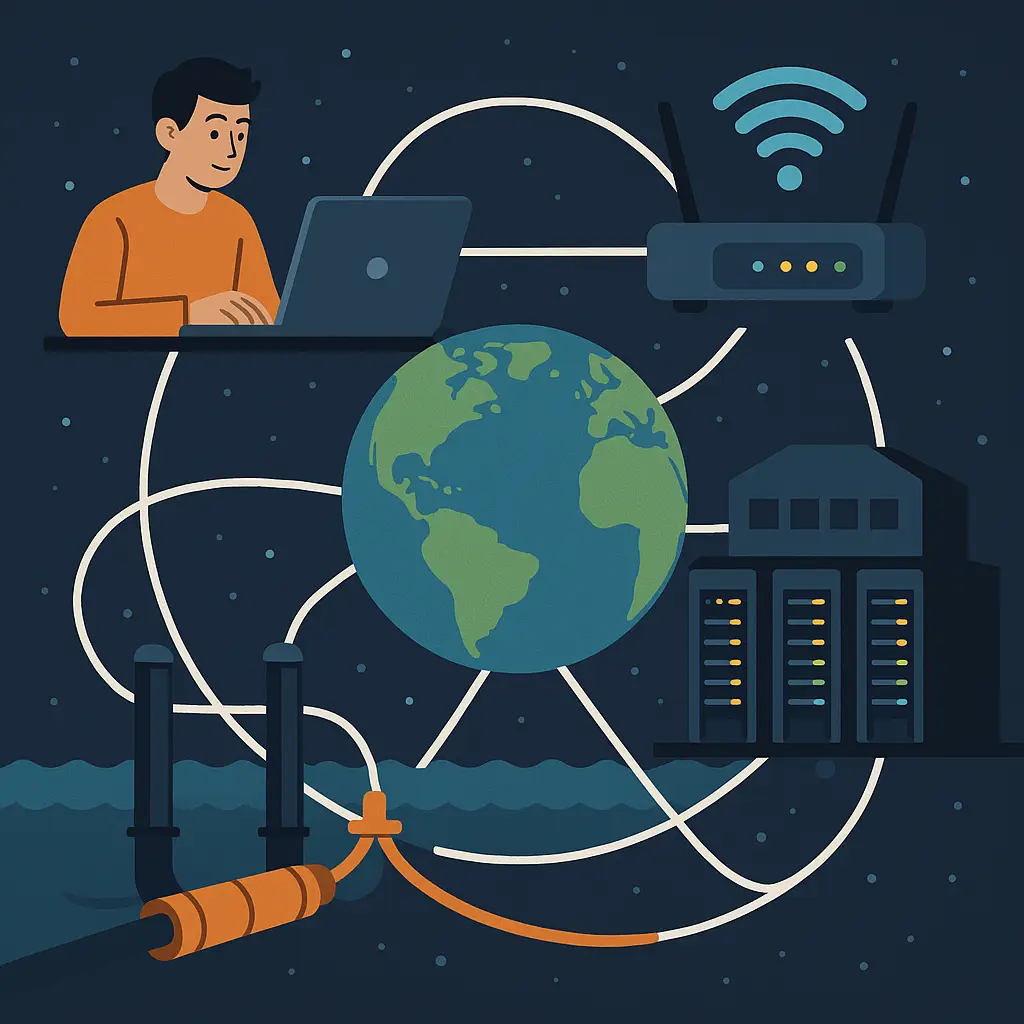
The Hidden World That Powers Your Digital Life 🌐
Every time you tap your phone screen, stream a video, or send a message, you’re accessing one of humanity’s most remarkable achievements: the global internet infrastructure. Yet most people have no idea how this invisible digital backbone actually works. Today, we’re diving deep into the fascinating world that powers your digital life – from the massive undersea cables spanning oceans to the tiny signals racing through fiber optic networks at the speed of light.
The Physical Internet: It’s More Real Than You Think 🏗️
Undersea Cables: The Ocean’s Hidden Highways 🌊
Contrary to popular belief, the internet isn’t floating in “the cloud” – it’s built on incredibly physical infrastructure. At the heart of global internet connectivity lies a network of over 400 undersea cables stretching across ocean floors worldwide. These cables, about the thickness of a garden hose, carry 99% of international internet traffic.
The Trans-Atlantic Cable systems connect North America to Europe, while the Trans-Pacific networks link Asia to the Americas. Each cable contains multiple fiber optic strands protected by layers of steel wire, copper, and waterproof coating. A single cable can carry terabits of data per second – enough to stream millions of HD videos simultaneously.
Companies like Google, Facebook, and Microsoft have invested billions in their own private undersea cables. Google’s “Dunant” cable, for instance, connects Virginia Beach to Saint-Hilaire-de-Riez in France, carrying data at speeds that would make your home internet connection look glacial.
Data Centers: The Internet’s Powerhouses ⚡
When you upload a photo to Instagram or save a document to Google Drive, where does it actually go? The answer lies in massive data centers – warehouse-sized facilities packed with thousands of servers running 24/7.
Tier 1 data centers represent the gold standard, featuring:
- Redundant power systems with backup generators
- Advanced cooling systems (servers generate enormous heat)
- Multiple internet connections from different providers
- Biometric security systems and 24/7 monitoring
Major tech companies operate “hyperscale” data centers. Amazon Web Services (AWS) alone operates over 80 data centers globally, while Google’s data centers consume roughly 0.1% of global electricity. These facilities are strategically located near power sources, fiber optic networks, and in regions with favorable climates for cooling.
Fiber Optic Networks: Light-Speed Communication 💡
The backbone of modern internet infrastructure relies on fiber optic cables – thin strands of glass that transmit data as pulses of light. Unlike traditional copper wires that send electrical signals, fiber optics offer several advantages:
Speed: Data travels through fiber at about 200,000 kilometers per second (roughly 2/3 the speed of light in a vacuum) Bandwidth: A single fiber strand can carry terabits of data Distance: Signals can travel hundreds of kilometers without degradation Reliability: Immune to electromagnetic interference
The global fiber optic network spans millions of kilometers, connecting continents, countries, cities, and ultimately reaching your neighborhood. When you’re streaming Netflix, light pulses carrying your movie data are racing through these glass highways at incomprehensible speeds.
How Data Travels: Your Digital Journey Explained 🚀
From Click to Content: The Millisecond Journey
Let’s trace what happens when you click a link on your phone:
- Device to Router: Your phone sends a signal to your home Wi-Fi router
- Router to ISP: The router forwards your request to your Internet Service Provider
- ISP to Backbone: Your ISP connects to major internet backbone networks
- Backbone to Destination: Your request travels through multiple networks to reach the target server
- Server Response: The destination server processes your request and sends data back
- Return Journey: The response follows the same path in reverse
This entire journey typically takes 20-100 milliseconds – faster than you can blink. The data might travel through dozens of routers, switches, and networks, potentially crossing multiple countries or continents.
Internet Exchange Points: Traffic Control Centers 🚦
Internet Exchange Points (IXPs) serve as crucial traffic hubs where different internet service providers connect and exchange data. Think of them as digital highway interchanges where multiple roads converge.
The DE-CIX in Frankfurt, Germany, is one of the world’s largest IXPs, handling over 9 terabits of peak traffic. These facilities enable efficient routing and reduce latency by allowing networks to exchange traffic locally rather than sending it halfway around the world.
DNS System: How www.google.com Becomes an IP Address 🔍
The Internet’s Phone Book
The Domain Name System (DNS) is arguably one of the internet’s most elegant inventions. Humans prefer remembering “google.com” over “142.250.190.14” (Google’s IP address), but computers need numerical addresses to locate resources.
Here’s how DNS works:
- Query Initiation: You type “google.com” in your browser
- Resolver Check: Your computer checks its local DNS cache
- Recursive Query: If not cached, your ISP’s DNS server takes over
- Root Server: The query reaches one of 13 root DNS servers worldwide
- TLD Server: The root server directs to a .com top-level domain server
- Authoritative Server: Finally, Google’s DNS server provides the IP address
- Response: The IP address travels back to your browser
This process typically completes in under 50 milliseconds, and the result is cached to speed up future requests.
DNS Security: Protecting Digital Identity 🛡️
DNS security is crucial because compromised DNS can redirect users to malicious websites. DNSSEC (DNS Security Extensions) adds cryptographic signatures to DNS records, ensuring authenticity and preventing tampering.
Internet Protocols: The Rules of Digital Communication 📋
TCP/IP: The Foundation Protocol Stack
The internet operates on a suite of protocols collectively known as TCP/IP:
IP (Internet Protocol): Handles addressing and routing of data packets TCP (Transmission Control Protocol): Ensures reliable, ordered data delivery UDP (User Datagram Protocol): Provides faster, connectionless communication HTTP/HTTPS: Governs web browsing and data transfer
Think of these protocols as the grammar and vocabulary of internet communication. Without them, devices couldn’t understand each other, regardless of manufacturer or operating system.
The OSI Model: Seven Layers of Communication 📚
Network professionals use the OSI (Open Systems Interconnection) model to understand how data moves through networks:
- Physical Layer: Cables, radio waves, electrical signals
- Data Link Layer: Frame formatting, error detection
- Network Layer: Routing, IP addressing
- Transport Layer: TCP/UDP, port numbers
- Session Layer: Connection management
- Presentation Layer: Encryption, compression
- Application Layer: HTTP, email, file transfer
Each layer has specific responsibilities, and problems at any layer can affect internet performance.
Cloud Computing Reality: Where Your Photos Actually Live ☁️
The Cloud is Someone Else’s Computer
When you save photos to iCloud or Google Photos, they’re not floating in some ethereal cloud – they’re stored on physical servers in data centers around the world. Cloud computing represents a fundamental shift from personal storage to distributed, on-demand computing resources.
Major cloud providers operate globally:
- Amazon Web Services (AWS): 30+ regions, 96 availability zones
- Microsoft Azure: 60+ regions worldwide
- Google Cloud Platform: 35+ regions, 106 zones
- Alibaba Cloud: Dominant in Asia-Pacific region
Your data is typically replicated across multiple locations for redundancy. When you access a file, sophisticated algorithms determine the optimal server to deliver it based on your location, network conditions, and server load.
Edge Computing: Bringing the Cloud Closer 🌍
To reduce latency, cloud providers deploy edge computing nodes closer to users. Content Delivery Networks (CDNs) cache popular content at edge locations worldwide. When you watch a YouTube video, it’s likely streaming from a server much closer to your location than Google’s main data centers.
Network Security: How Encryption Protects Your Data 🔐
HTTPS: The Secure Web
The “S” in HTTPS stands for “Secure,” indicating that data between your browser and websites is encrypted. This encryption uses complex mathematical algorithms to scramble data, making it unreadable to anyone intercepting it.
TLS (Transport Layer Security) provides this encryption through:
- Public Key Cryptography: Asymmetric encryption for initial key exchange
- Symmetric Encryption: Faster encryption for bulk data transfer
- Digital Certificates: Verify website identity and prevent impersonation
VPNs: Private Tunnels Through Public Networks 🔒
Virtual Private Networks (VPNs) create encrypted tunnels through public internet infrastructure. When you connect to a VPN, your data is encrypted before leaving your device and decrypted at the VPN server, hiding your activities from your ISP and potential eavesdroppers.
Internet Governance: Who Controls the Internet? 🏛️
A Distributed System of Governance
Unlike traditional infrastructure, the internet has no central authority. Instead, various organizations coordinate different aspects:
ICANN (Internet Corporation for Assigned Names and Numbers): Manages domain names and IP address allocation IETF (Internet Engineering Task Force): Develops internet standards and protocols W3C (World Wide Web Consortium): Creates web standards Regional Internet Registries: Allocate IP addresses regionally
This distributed governance model has enabled the internet’s rapid growth while maintaining technical standards and interoperability.
Net Neutrality: The Ongoing Debate ⚖️
Net neutrality principles require ISPs to treat all internet traffic equally, without blocking, throttling, or prioritizing certain content. This debate continues globally, with different countries adopting varying approaches to internet regulation.
Speed Factors: Why Your Internet Is Slow (And How to Fix It) 🐌
The Bottleneck Effect
Internet speed depends on the slowest link in your connection chain. Common bottlenecks include:
Last-Mile Connectivity: The connection from your ISP to your home Network Congestion: Too many users competing for bandwidth Server Performance: Overloaded destination servers Physical Distance: Longer distances increase latency Network Equipment: Outdated routers and modems
Optimizing Your Connection 🚀
To improve internet performance:
- Upgrade your router: Modern Wi-Fi 6 routers offer better performance
- Ethernet connections: Wired connections are faster than Wi-Fi
- QoS settings: Prioritize important traffic
- DNS optimization: Use faster DNS servers like 1.1.1.1 or 8.8.8.8
- Bandwidth monitoring: Identify bandwidth-hungry applications
Future of Internet: 6G, Satellite Internet, and Quantum Networks 🔮
6G: The Next Generation
While 5G networks are still rolling out globally, researchers are already developing 6G technology, expected by 2030. 6G promises:
- Speeds up to 1 terabit per second
- Sub-millisecond latency
- Holographic communications
- AI-integrated network management
Satellite Internet Revolution 🛰️
Companies like SpaceX (Starlink), Amazon (Project Kuiper), and OneWeb are deploying massive satellite constellations to provide global internet coverage. These low-Earth orbit satellites offer:
- Global coverage, including remote areas
- Lower latency than traditional satellite internet
- Redundancy and disaster resilience
Quantum Networks: The Ultimate in Security 🔬
Quantum networking represents the future of ultra-secure communications. Quantum key distribution uses quantum mechanics principles to detect any interception attempts, making communications theoretically unbreakable.
China has already deployed quantum communication networks for government use, while research continues on quantum internet infrastructure that could revolutionize secure communications.
Global Digital Divide: Internet Access Around the World 🌍
The Connected and Disconnected
Despite the internet’s global reach, significant disparities remain:
- Urban vs. Rural: Rural areas often lack high-speed infrastructure
- Developed vs. Developing: Wealthier nations have better connectivity
- Economic Barriers: Internet access costs vary dramatically worldwide
- Digital Literacy: Technical knowledge affects internet utilization
Bridging the Gap 🌉
Various initiatives aim to expand internet access:
- Google’s Project Loon: Balloon-based internet (now discontinued)
- Facebook’s Connectivity programs: Partnering with local providers
- Government initiatives: National broadband plans
- Community networks: Local, grassroots connectivity projects
The Environmental Impact of Digital Infrastructure 🌱
The Carbon Footprint of the Internet
Our digital lives have environmental consequences:
- Data centers consume 1% of global electricity
- Cryptocurrency mining requires enormous energy
- Device manufacturing involves rare earth elements
- Electronic waste from outdated equipment
Sustainable Solutions ♻️
The tech industry is addressing these challenges:
- Renewable energy: Google and Microsoft are carbon-neutral
- Efficient hardware: New processors consume less power
- Edge computing: Reduces data center load
- Circular economy: Recycling and refurbishing equipment
Conclusion: The Marvel of Modern Connectivity 🎯
The internet infrastructure represents one of humanity’s greatest collaborative achievements. From the physical cables crossing ocean floors to the quantum networks of tomorrow, this invisible backbone enables our connected world.
Understanding how the internet actually works – from DNS lookups to data center operations – helps us appreciate the complexity behind our simple clicks and taps. As we move toward an increasingly digital future with 6G networks, satellite internet, and quantum communications, this infrastructure will continue evolving to meet our growing connectivity needs.
The next time you send a message, stream a video, or upload a photo, remember the incredible journey your data takes through this hidden world of cables, servers, and switches. It’s a testament to human ingenuity and cooperation – a global network that has fundamentally transformed how we live, work, and communicate.
Key Takeaway: The internet isn’t magic – it’s engineering. Behind every digital interaction lies a sophisticated infrastructure of physical hardware, protocols, and systems working in harmony to deliver information at the speed of light. Understanding this infrastructure helps us better appreciate the digital age and make informed decisions about our online lives.
Want to dive deeper into specific aspects of internet infrastructure? Explore networking courses, visit data centers during public tours, or consider a career in network engineering – the field that keeps our digital world running smoothly.